

Apr 21, 2026 Step by Step Guide to Prepare for GES-C01 Exam BrainDumps
Snowflake Certification GES-C01 Real Exam Questions and Answers FREE Updated on 2026
NEW QUESTION # 210
A data analyst is using Snowflake Copilot in Snowsight to generate SQL queries for a new dataset containing customer PII. Which of the following statements accurately describes how Snowflake Copilot operates with respect to data access, governance, and model interaction?
- A. To protect sensitive information, Snowflake Copilot transmits sampled PII data to an external LLM for schema understanding before generating SQL.
- B. Snowflake Copilot requires explicit column-level grants for direct data access, similar to how a human analyst would query specific data points.
- C. While Snowflake Copilot generates SQL based on metadata, the generated SQL queries are executed in an isolated environment that does not respect existing Snowflake RBAC policies.
- D. Snowflake Copilot directly accesses and processes the raw data within customer tables to understand its content and generate SQL.
- E. Snowflake Copilot is powered by a fine-tuned model that runs securely inside Snowflake Cortex, leveraging only database/schema/table/column names and data types, ensuring data remains within Snowflake's governance boundary and respects RBAC.
Answer: E
Explanation:
Snowflake Copilot is an LLM-powered assistant that is powered by a model fine-tuned by Snowflake, running securely inside Snowflake Cortex. It ensures that your enterprise data and metadata always stay securely inside Snowflake and fully respects RBAC. Crucially, Snowflake Copilot does not have access to the data inside your tables; it generates responses based on the names of your databases, schemas, tables, and columns, and their data types. Options A and C are incorrect because Copilot does not directly access or transmit customer data. Option D is incorrect as it implies direct data access, which Copilot does not perform. Option E is incorrect because Copilot fully integrates with Snowflake's RBAC policies.
NEW QUESTION # 211
A data analytics team is building a Retrieval Augmented Generation (RAG) application to provide contextual answers from a vast repository of internal documents stored in Snowflake. They are evaluating different strategies for generating and retrieving text embeddings to optimize the overall RAG pipeline's performance and relevance. Which of the following statements accurately describe performance considerations related to embedding generation and retrieval in this RAG context? (Select all that apply)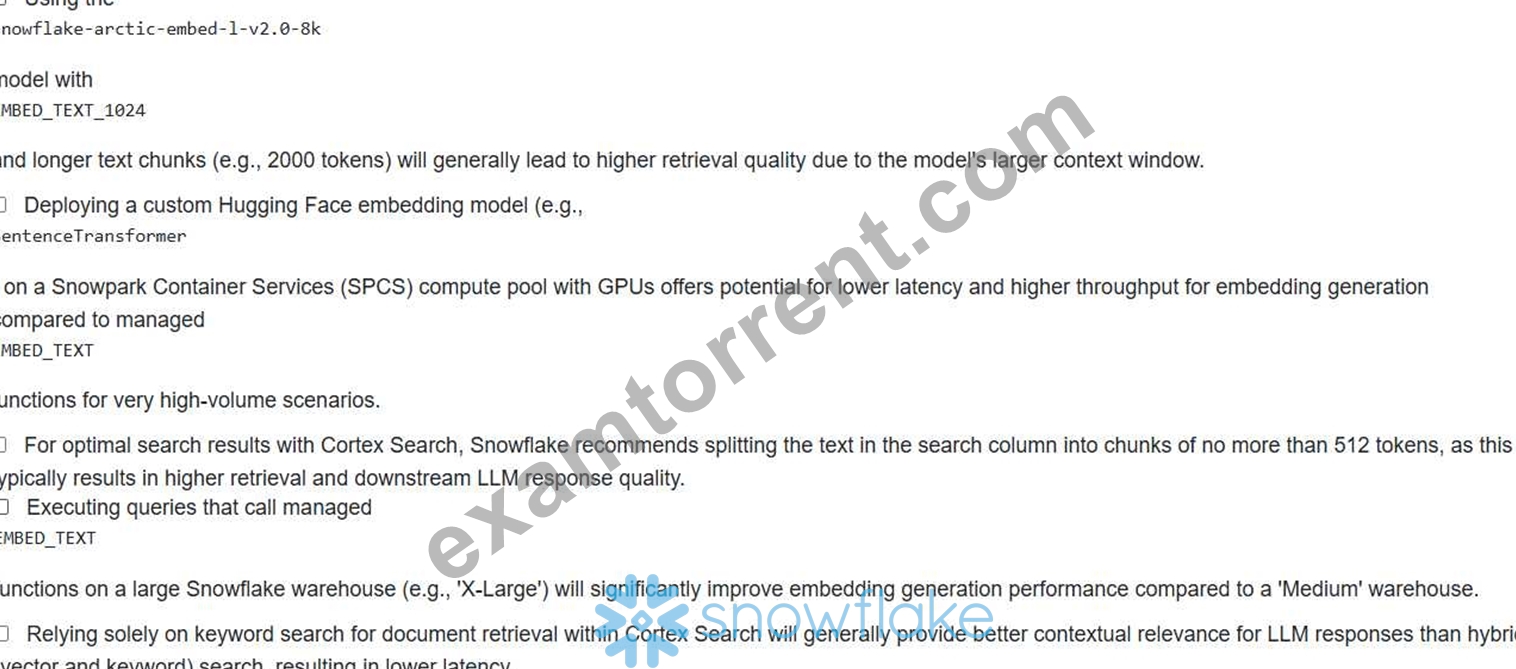
- A. Option D
- B. Option A
- C. Option C
- D. Option B
- E. Option E
Answer: C,D
Explanation:
For optimizing RAG pipeline performance and relevance: ' This statement is incorrect. Snowflake's documentation explicitly recommends splitting text into smaller chunks (no more than 512 tokens) for Cortex Search to achieve optimal retrieval and downstream LLM response quality. This holds true even with models that have larger context windows like 'snowflake-arctic-embed-l-v2.0-8k' , because smaller chunks lead to more precise retrieval. * **B:** Deploying custom models like a Hugging Face 'sentenceTransformeN on Snowpark Container Services (SPCS) with GPU compute pools (e.g., *GPU or *GPU NV_M') is optimized for intensive GPU usage scenarios like LLMs/VLMs. This can provide lower latency and higher throughput for embedding generation in very high-volume, custom scenarios, offering more control than managed functions. ' This statement is correct. Snowflake's documentation clearly states that for best search results with Cortex Search, it is recommended to split the text in the search column into chunks of no more than 512 tokens. This strategy typically results in higher retrieval and better quality responses from downstream LLMs. * This statement is incorrect. Snowflake explicitly advises executing queries that call Cortex AI SQL functions (including ' EMBED_TEXT') with a *smaller* warehouse (no larger than MEDIUM), as larger warehouses do not increase performance for these specific functions. * *E:" This statement is incorrect. Cortex Search powers RAG applications by leveraging *semantic search*, which combines both vector and keyword search capabilities, to provide customized, contextualized responses. Relying solely on keyword search would generally yield less contextual relevance for LLM responses than a hybrid approach.
NEW QUESTION # 212
A global marketing team uses Snowflake to manage customer feedback in various languages. They need to translate customer reviews from German ("de") into English ("en") for analysis. The reviews are stored in a table named 'CUSTOMER REVIEWS' in a column called 'REVIEW TEXT'. Which of the following SQL statements correctly applies the 'SNOWFLAKE.CORTEX.TRANSLATE function and what is the expected return type for the translated text?
- A. The query

- B. The query

- C. The query

- D. The query

- E. The query

Answer: D
Explanation:
Option B is correct. The 'SNOWFLAKE.CORTEX.TRANSLATE function takes three arguments: the text to be translated, the source language, and the target language. It returns a STRING value containing the translated text. Option A includes an unsupported 'high_accuracy' option and claims an incorrect return type. Option C uses an incorrect syntax and claims an incorrect return type. Option D uses an incorrect number of arguments. Option E claims an incorrect return type.
NEW QUESTION # 213
A machine learning team has fine-tuned a llama3.1-70b model for a specialised task using Snowflake Cortex Fine-tuning, named prod_llama_responder. They now need to deploy this model for inference via the Cortex REST API across different Snowflake regions and manage its lifecycle effectively. Which of the following statements regarding the fine-tuned model's deployment, access, and management are accurate?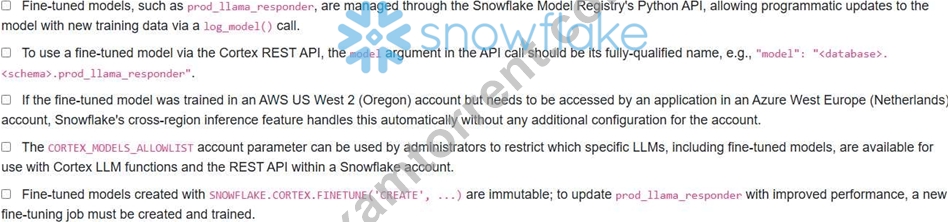
- A. Option C
- B. Option E
- C. Option A
- D. Option D
- E. Option B
Answer: B,D,E
Explanation: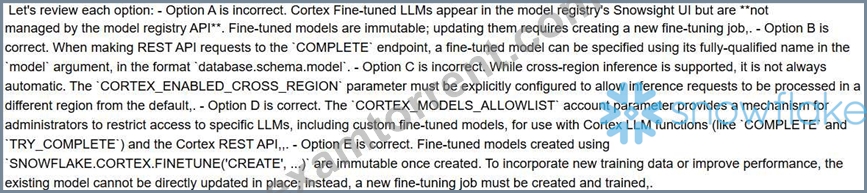
NEW QUESTION # 214 
After resolving this, they try to process a batch of 1500 documents in a single query using the method, which also fails. Which two issues are most likely contributing to these failures?
- A. The 'SNOWFLAKE.DOCUMENT INTELLIGENCE CREATOR database role or the 'CREATE SNOWFLAKE.ML.DOCUMENT INTELLIGENCE' privilege on the schema has not been granted to the .
- B. The name is not unique within the .
- C. The virtual warehouse being used for Document AI is not a Snowpark-optimized warehouse.
- D. The has not been granted the 'CREATE STREAM' privilege on the
- E. The batch of documents exceeds Document AI's limit of 1000 documents per query.
Answer: A,E
Explanation:
The initial error, 'Unable to create a build on the specified database and schema,' is a documented message that can occur if the 'CREATE SNOWFLAKE.ML.DOCUMENT_INTELLIGENCE' privilege is not granted to the role, or if the database role is missing. Thus, option B is a direct and likely cause for the first failure. After resolving this (meaning the model build was successfully created), the subsequent failure to process 1500 documents in a single query is due to Document AI's limitation of processing a maximum of 1000 documents per query. Therefore, option D correctly identifies the second contributing factor. Option A (CREATE STREAM' privilege) is relevant for creating pipelines but not for the initial model build or predicting. Option C (duplicate model build name) is another possible cause for the first error, but the question asks for the 'most likely' issues across two distinct failures, making B a more fundamental access control issue for creation and D a clear limit for processing. Option E (Snowpark-optimized warehouse) is not a specific requirement or a known cause for these types of errors; an X-Small, Small, or Medium warehouse is generally recommended, and scaling up does not increase processing speed.
NEW QUESTION # 215
A business user frequently asks Cortex Analyst questions that require filtering on specific product names, such as "What were the sales for 'iced tea' last month?" The 'product' dimension has many distinct values (high cardinality), and Cortex Analyst sometimes struggles to accurately identify the exact literal product name, leading to less precise SQL queries. The Gen AI Specialist wants to enhance Cortex Analyst's ability to find these literal values for the 'product' dimension. To improve Cortex Analyst's literal search capability for the high-cardinality 'product' dimension, which of the following is the most appropriate and recommended approach to configure in the semantic model?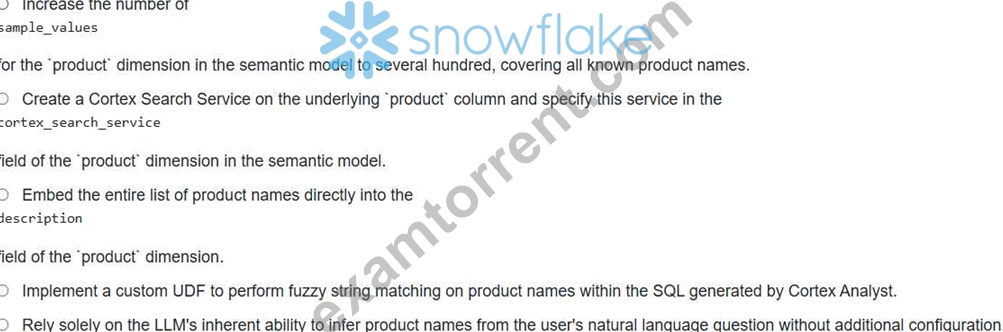
- A. Option C
- B. Option D
- C. Option A
- D. Option B
- E. Option E
Answer: D
Explanation:
Cortex Analyst offers solutions to improve literal usage, including semantic search over sample values in the semantic model and semantic search using Cortex Search Services. For dimensions with high cardinality (many distinct values), creating a Cortex Search Service on the underlying column and specifying it in the field of the dimension within the semantic model is the recommended approach. This allows for high-quality "fuzzy" search to find literal values needed for Cortex Analyst's SQL queries. Option A is less effective for high-cardinality dimensions because only a fixed-size set of sample values is presented to the LLM, regardless of how many are provided. Option C is not the intended use for the 'description' field and could exceed context window limits. Option D, while a possible technical solution, bypasses the integrated and optimized Cortex Search functionality designed for this purpose. Option E is explicitly contradicted by the scenario, which indicates the LLM struggles, and the available solutions are designed to address this limitation.
NEW QUESTION # 216
An ML Engineer has successfully deployed a custom text embedding model, 'my_embedder model', to a Snowpark Container Service named 'text embedding_service' within their Snowflake account. This model has an 'encode' method that accepts a string and returns a vector. They now need to integrate inference calls from this deployed model into various applications. Which of the following are valid ways to invoke this model for inference?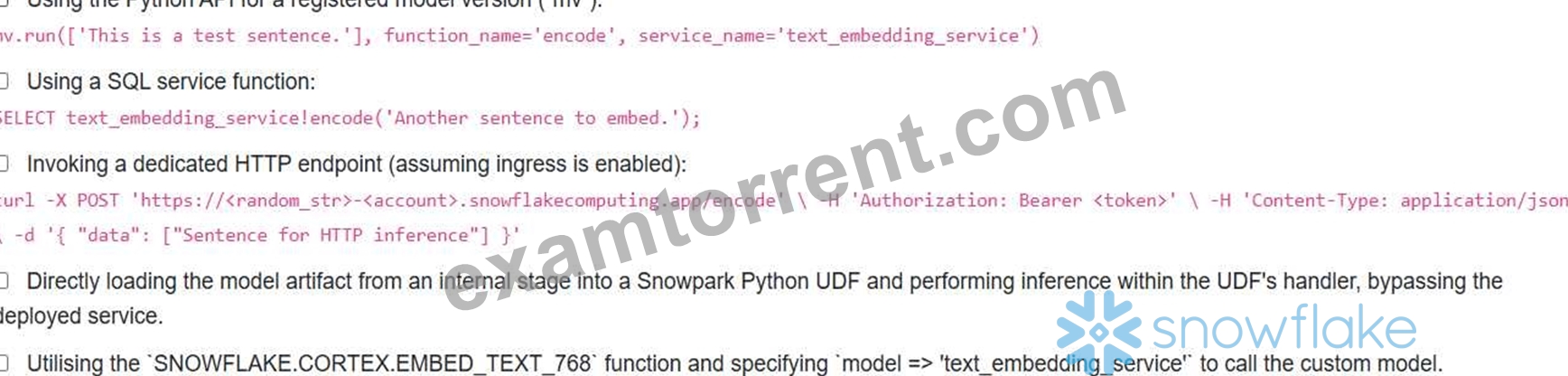
- A. Option D
- B. Option A
- C. Option C
- D. Option B
- E. Option E
Answer: B,C,D
Explanation:
Option A is correct because the 'run' method of a 'ModelVersion' object is used to perform inference on models deployed to Snowpark Container Services via the Python API. Option B is correct because Snowflake Model Serving creates SQL service functions, named as 'service_name!method_name', to act as a bridge from SQL to the model running in SPCS. Option C is correct because if ingress is enabled during service creation, the model can be invoked via a dedicated HTTP endpoint. Option D is incorrect because this approach would bypass the deployed Snowpark Container Service entirely, and models deployed to SPCS are intended to be run there, not re-loaded into a standard UDF runtime, which might have different environments or resource constraints. Option E is incorrect because is a built-in Snowflake Cortex LLM function, not a mechanism to call a custom model deployed via the Model Registry and Snowpark Container Services. The model argument for Cortex functions expects specific pre-defined model names, not custom service names.
NEW QUESTION # 217
A data engineering team is building a pipeline in Snowflake that uses a SQL task to call various Snowflake Cortex LLM functions (e.g., AI_COMPLETE, AI EMBED) on large datasets of customer interaction logs. The team observes fluctuating costs and occasional query failures, which sometimes halt the pipeline. To address these issues and ensure an efficient, robust, and monitorable pipeline, which of the following actions or considerations are essential? (Select all that apply.)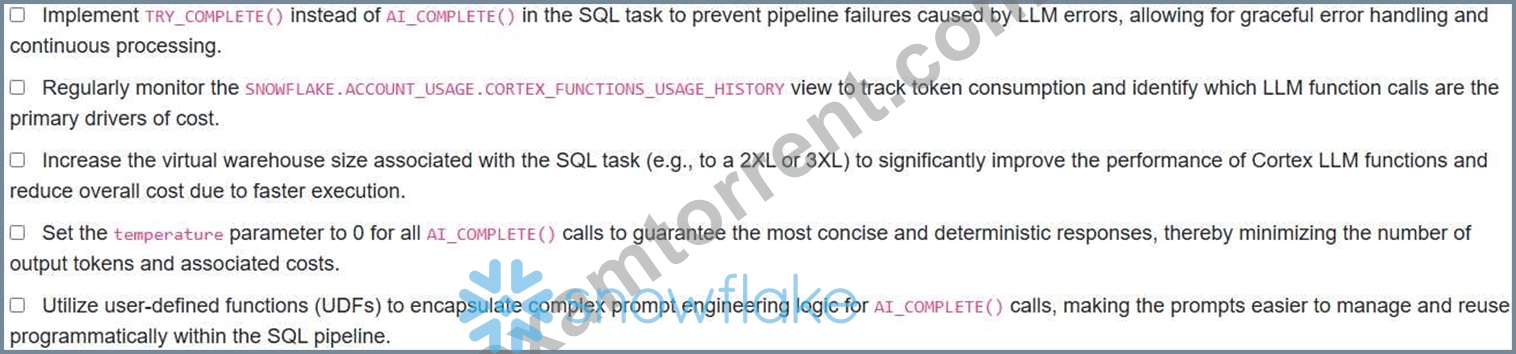
- A. Option C
- B. Option E
- C. Option D
- D. Option A
- E. Option B
Answer: B,D,E
Explanation:
A). "Correct." The 'TRY function is designed to perform the same operation as but returns 'NULL ' instead of raising an error when the LLM operation cannot be performed. This is critical for building robust data pipelines, as it prevents pipeline halts due to transient or specific LLM failures, allowing for more resilient data processing. B. ' The view provides detailed information on token consumption and credit usage for Snowflake Cortex LLM functions. Monitoring this view is essential for understanding cost drivers and optimizing expenditure within AI pipelines. C. "Incorrect." Snowflake recommends executing queries that call Cortex AISQL functions with a smaller warehouse (no larger than MEDIUM), as larger warehouses do not necessarily increase performance but can lead to unnecessary costs. The LLM inference itself runs on Snowflake-managed compute, not solely on the user's virtual warehouse compute size. D. ' Setting the 'temperature' parameter to 0 makes the LLM's output more deterministic and focused. While this can be beneficial for consistency in certain tasks, it does not directly minimize token usage. Token usage is primarily determined by the length of the input prompt and the length of the generated output, which can vary regardless of 'temperature'. E. "Correct." Encapsulating complex and potentially lengthy prompt logic within a UDF CUSER DEFINED FUNCTION') makes the prompts more manageable, reusable, and easier to integrate programmatically into SQL statements within a data pipeline. This improves code organization and maintainability.
NEW QUESTION # 218
A data engineering team is setting up an automated pipeline to extract information from new invoices using Document AI. They've created a database and schema Cinvoice_db.invoice_schema') and a Document AI model build ('invoice_extractor'). They then created an internal stage for documents. When they attempt to run the 'invoice_extractor!PREDlCT' method on documents uploaded to 'invoice_stage' , they consistently receive the following error:
Given this error message, which 'corrective SQL command' addresses the most likely misconfiguration of the 'invoice_stage' to allow Document AI processing?
- A.

- B.

- C.

- D.

- E.

Answer: C
Explanation: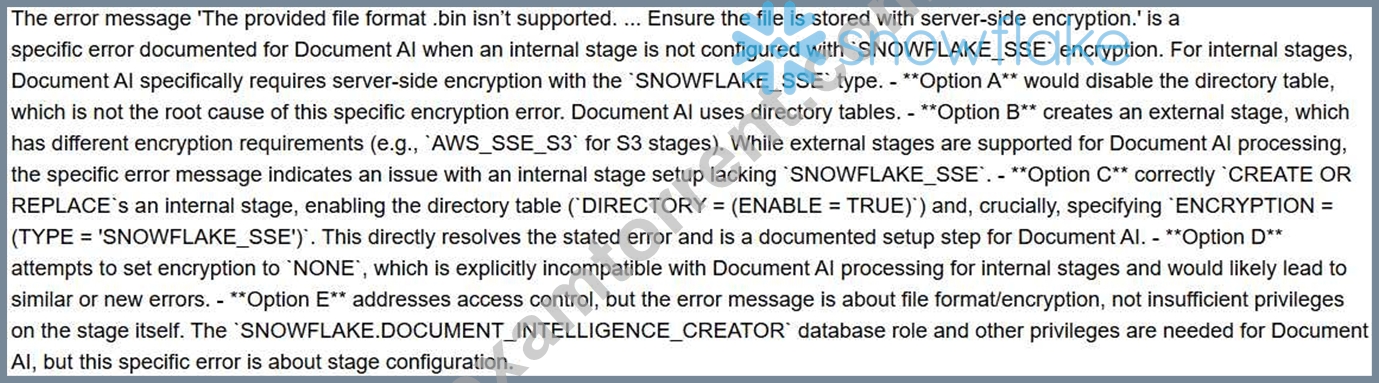
NEW QUESTION # 219
A data engineering team is setting up an automated pipeline to extract information from new invoices using Document AI. They've created a database and schema Cinvoice_db.invoice_schema') and a Document AI model build They then created an internal stage for documents. When they attempt to run the method on documents uploaded to 'invoice_stage' , they consistently receive the following error:
Given this error message, which 'corrective SQL command' addresses the most likely misconfiguration of the 'invoice_stage' to allow Document AI processing?
- A.

- B.

- C.

- D.

- E.

Answer: A
Explanation: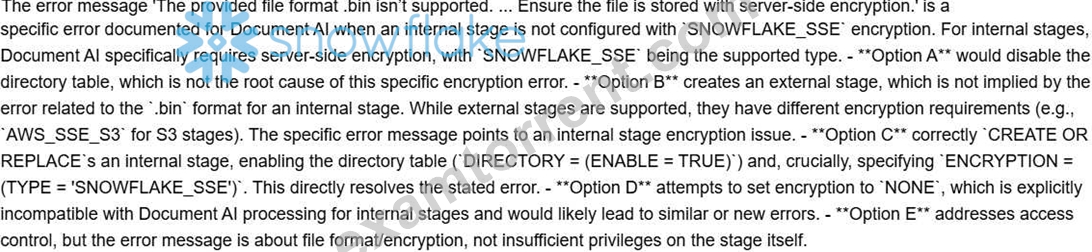
NEW QUESTION # 220
A Gen AI developer has a Document AI pipeline that uses a query with 'GET PRESIGNED URL' to process multi-page PDF documents. Despite the internal stage being correctly set up with 'SNOWFLAKE SSE' encryption and the model build being published, they observe inconsistent results. Some documents result in a Received HTTP 403 response for presigned URL. URL may be expired.
error, while other documents (containing complex diagrams and dense text in an unsupported language like Korean) are processed, but the extracted information is often incomplete or inaccurate.
Which two factors are most likely contributing to these observed issues?
- A. The role lacks the 'EXECUTE TASK' privilege, preventing the scheduled pipeline tasks from running.
- B. The Document AI model is returning answers longer than its limit of 512 tokens for entity extraction or 2048 tokens for table extraction.
- C. The default expiration time for the 'GET PRESIGNED URL' function is causing some URLs to expire before the Document AI model can process them.
- D. The documents are in an unsupported language or exceed the maximum page length of 125 pages, causing extraction failures or inaccuracies.
- E. The '!PREDICT method is being called with an outdated model build version instead of the latest one, leading to performance degradation.
Answer: C,D
Explanation:
The error 'Received HTTP 403 response for presigned URL. URL may be expired.' directly indicates that the function's default expiration time is causing some documents to be inaccessible by the Document AI model. This is a common issue when processing pipelines encounter delays. Additionally, the observation of incomplete or inaccurate extraction for documents with 'dense text in an unsupported language like Korean' directly points to language limitations. Document AI explicitly lists supported languages (English, Spanish, French, German, Portuguese, Italian, and Polish) and states that results for other languages might not be satisfactory. While the question mentions 'multi-page PDF documents' without explicitly stating they exceed page limits, the mention of 'complex diagrams and dense text' can also imply potential issues if page length (max 125 pages) is exceeded or other document requirements are not met. Thus, option D comprehensively covers these content- related issues. Option A (outdated model version) is unlikely to cause these specific errors, as the latest model is used by default if not specified. Option C (missing 'EXECUTE TASK privilege) would prevent task execution entirely, not cause intermittent URL issues or content- specific extraction problems. Option E (answers exceeding token limits) would be reflected in truncated output, not necessarily 'incomplete or inaccurate' extraction in the sense of failing to identify information in the first place.
NEW QUESTION # 221
A financial analyst wants to build a generative AI application in Snowflake that can answer complex queries by integrating financial reports (unstructured data in stages) and transaction records (structured data in tables). They decide to use Snowflake Cortex Agents. Which of the following statements accurately describe the capabilities and operational aspects of Cortex Agents in this scenario?
(Select all that apply)
- A. The primary compute cost for Cortex Agents is based on the number of tokens processed during the planning and reflection phases, with an additional per- message charge for each tool invocation.
- B. For monitoring agent interactions and performance on the client application, the TruLens Python packages (
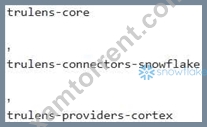
- C. To provide the Agent with custom logic for specific data transformations not covered by standard tools, stored procedures or user-defined functions (UDFs) can be implemented as custom tools.
- D. Cortex Agents are designed to orchestrate tasks by planning steps, utilising tools like Cortex Analyst for structured data and Cortex Search for unstructured data, and generating comprehensive responses.
- E. When a user asks an ambiguous question, Cortex Agents utilise an 'Explore options' component to consider different permutations and disambiguate the query for improved accuracy.
Answer: B,C,D,E
Explanation:
Option A is correct. Cortex Agents orchestrate across both structured and unstructured data sources, planning tasks, using tools (including Cortex Analyst and Cortex Search), and generating responses. Option B is correct. Stored procedures and user-defined functions (UDFs) can be used to implement custom tools for Cortex Agents. Option C is correct. The 'Explore options' component of Cortex Agents considers different permutations to disambiguate ambiguous questions, which is part of their orchestration capabilities to improve accuracy. Option D is incorrect. While Cortex Agents utilise LLMs and other Cortex features that incur token or message-based costs, the sources do not explicitly state that the *agent itself* has a primary compute cost based on 'planning and reflection phases' with an 'additional per-message charge for each tool invocation'. The cost of underlying services like Cortex Analyst is '67 Credits per 1,000 messages' and LLM calls via COMPLETE incur token costs, but this option inaccurately describes the agent's direct cost model. Option E is correct. TruLens Python packages (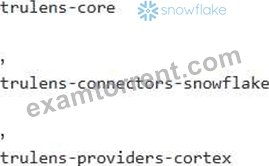
) are used for monitoring Agent interaction on the client application.
NEW QUESTION # 222
A data science team is planning to implement a new RAG (Retrieval Augmented Generation) application using Snowflake Cortex, specifically leveraging Cortex Search. They are evaluating the key features, best practices, and cost considerations associated with Cortex Search. Which of the following statements accurately describe aspects of Cortex Search?
- A. For best search results, Snowflake recommends splitting text in the search column into chunks of no more than 512 tokens, even when longer-context embedding models are available.
- B. Cortex Search Services require a virtual warehouse for initial setup and subsequent refreshes to run queries against base objects and build the search index.
- C. Cortex Search automatically handles embedding, infrastructure maintenance, and ongoing index refreshes, and can be used as a backend for enterprise search or a RAG engine for LLM chatbots.
- D. Cortex Search supports only English-only embedding models; multilingual RAG applications require external embedding solutions.
- E. The credit cost for Cortex Search Services is primarily based on the number of queries executed against the service, not the amount of indexed data.
Answer: A,B,C
Explanation:
Option A is correct. Cortex Search provides low-latency, high-quality 'fuzzy' search and handles embedding, infrastructure maintenance, search quality parameter tuning, and ongoing index refreshes. Its primary use cases are as a RAG engine for LLM chatbots and as a backend for enterprise search. Option B is incorrect. Cortex Search Services incur costs based on the amount of indexed data (6.3 Credits per GB/mo of indexed data), not solely on the number of queries executed. Option C is incorrect. Cortex Search offers multilingual embedding models like 'snowflake-arctic-embed-l-v2.ff and 'voyage-multilingual-2 , supporting multilingual AI workflows. Option D is correct. Snowflake recommends splitting text into chunks of no more than 512 tokens for optimal search results, as smaller chunks can lead to more precise retrieval and higher-quality LLM responses in RAG scenarios, even with models that support longer context windows. Option E is correct. A virtual warehouse is required for Cortex Search Service to refresh the service, which includes running queries against base objects, orchestrating text embedding jobs, and building the search index.
NEW QUESTION # 223
A Gen AI specialist is preparing to upload a large volume of diverse documents to an internal stage for Document AI processing. The objective is to extract detailed information, including lists of items and potentially classifying document types, and then automate this process. Which of the following statements represent 'best practices or important considerations/limitations' when preparing documents and setting up the Document AI workflow in Snowflake? (Select ALL that apply.)
- A. Documents with a page count exceeding 125 pages or a file size greater than 50 MB will be processed, but with a potential reduction in extraction accuracy.
- B. If the Document AI model does not find an answer for a specific field, the '!PREDICT method will omit the 'value' key but will still return a 'score' key to indicate confidence that the answer is not present.
- C. For continuous processing of new documents, it is best practice to create a stream on the internal stage and a task to automate the '!PREDICT method execution.
- D. To improve model training, documents uploaded should represent a real use case, and the dataset should consist of diverse documents in terms of both layout and data.
- E. When defining data values for extraction, especially for nonstandard formats or combinations of values, fine-tuning the model with annotations is generally more effective than relying solely on complex prompt engineering.
Answer: B,C,D,E
Explanation: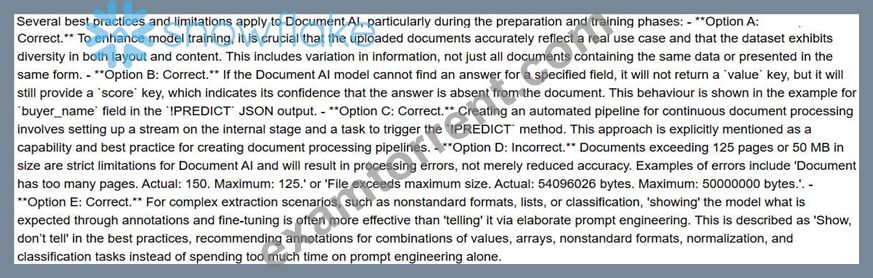
NEW QUESTION # 224
A Streamlit application developer wants to use AI_COMPLETE (the latest version of COMPLETE (SNOWFLAKE. CORTEX)) to process customer feedback. The goal is to extract structured information, such as the customer's sentiment, product mentioned, and any specific issues, into a predictable JSON format for immediate database ingestion. Which configuration of the AI COMPLETE function call is essential for achieving this structured output requirement?
- A. Option D
- B. Option A
- C. Option B
- D. Option C
- E. Option E
Answer: D
Explanation:
'AI_COMPLETE Structured OutputS (and its predecessor 'COMPLETE Structured Outputs') specifically allows supplying a JSON schema as the 'response_format' argument to ensure completion responses follow a predefined structure. This significantly reduces the need for post-processing and enables seamless integration with systems requiring deterministic responses. The JSON schema object defines the structure, data types, and constraints, including required fields. While prompting the model to 'Respond in JSON' can improve accuracy for complex tasks, the 'response_format' argument is the direct mechanism for enforcing the schema. Option A is a form of prompt engineering, which can help but does not guarantee strict adherence as 'response_format' does. Option B controls randomness and length, not output structure. Option D is less efficient for extracting multiple related fields compared to a single structured output call. Option E's 'guardrails' are for filtering unsafe or harmful content, not for enforcing output format.
NEW QUESTION # 225
A data engineering team is setting up an automated pipeline in Snowflake to process call center transcripts. These transcripts, once loaded into a raw table, need to be enriched by extracting specific entities like the customer's name, the primary issue reported, and the proposed resolution. The extracted data must be stored in a structured JSON format in a processed table. The pipeline leverages a SQL task that processes new records from a stream. Which of the following SQL snippets and approaches, utilizing Snowflake Cortex LLM functions, would most effectively extract this information and guarantee a structured JSON output for each transcript?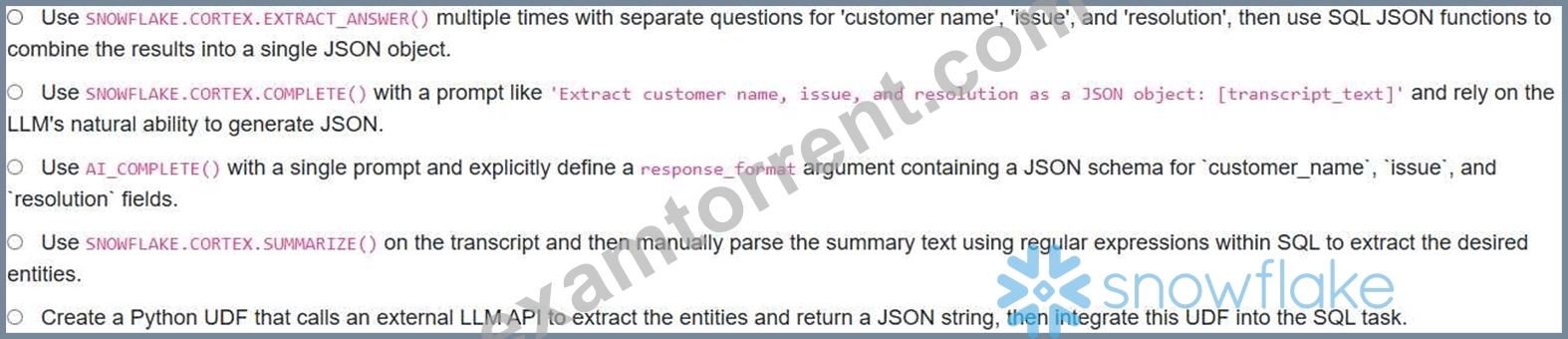
- A. Option D
- B. Option A
- C. Option B
- D. Option C
- E. Option E
Answer: D
Explanation:
To guarantee a structured JSON output for entity extraction, (the updated version of 'COMPLETE()') with the response_format' argument and a specified JSON schema is the most effective approach. This mechanism enforces that the LLM's output strictly conforms to the predefined structure, including data types and required fields, significantly reducing the need for post-processing and improving data quality within the pipeline. Option A requires multiple calls and manual JSON assembly, which is less efficient. Option B relies on the LLM's 'natural ability' to generate JSON, which might not be consistently structured without explicit 'response_format' . Option D uses , which is for generating summaries, not structured entity extraction. Option E involves external LLM API calls and Python UDFs, which, while possible, is less direct than using native 'AI_COMPLETE structured outputs within a SQL pipeline in Snowflake Cortex for this specific goal.
NEW QUESTION # 226
A team of data application developers is leveraging Snowflake Copilot to streamline the creation of analytical SQL queries within their Streamlit in Snowflake application. They observe that Copilot sometimes struggles with complex joins or provides suboptimal queries when dealing with a newly integrated, deeply nested dataset. Based on Snowflake's best practices and known limitations, which actions or considerations would help improve Copilot's performance in this scenario?
- A. Break down complex requests into simpler, multi-turn questions, as Copilot is designed to build complex queries through conversational refinement and follow-up questions.
- B. Ensure that a database and schema are explicitly selected for the current session, and that column names are meaningful, to provide Copilot with better context for query generation.
- C. Enable the CORTEX_MODELS_ALLOWLIST parameter to restrict Copilot to only use the largest available LLMs, thereby guaranteeing higher accuracy for complex queries.
- D. Grant Copilot direct access to the raw data using ACCOUNTADMIN privileges, allowing it to infer schema relationships more effectively from data content.
- E. Implement curated views with descriptive and easy-to-understand names for views and columns, appropriate data types, and pre-define common/complex joins to simplify the underlying schema for Copilot.
Answer: A,B,E
Explanation:
To improve Snowflake Copilot's performance, creating curated views with descriptive names, appropriate data types, and capturing common/complex joins is a key best practice. Copilot can build complex queries through a conversation by asking follow-up questions. It also uses the names of databases, schemas, tables, and columns, and their data types to determine available data, so ensuring these are meaningful and correctly set for the session is crucial for relevant responses. Option B is incorrect because CORTEX_MODELS_ALLOWLIST controls access to specific LLMs but doesn't guarantee higher accuracy for Copilot's SQL generation. Option D is incorrect as Snowflake Copilot does not have access to the data inside tables; it operates on metadata. Granting privileges would not change this fundamental operational principle and is ACCOUNTADMIN against best practices for least privilege.
NEW QUESTION # 227
A Snowflake administrator needs to implement a granular access control strategy for LLMs. The general policy is to restrict access to a select few models via an account-level allowlist. However, a specific data science team (using role 'DATA SCIENCE TEAM ROLE) requires access to the 'claude-3-5-sonnet' model, which should not be available to other users or globally via the allowlist. Given this scenario, which set of commands would correctly establish this access control while adhering to the specified requirements?
- A.

- B.

- C.

- D.

- E.

Answer: D
Explanation:
Option A is correct. This sequence of commands sets an account-level allowlist for 'mistral-large? and 'snowflake-arctic' , thereby restricting general access to other models. It then explicitly grants the access to the 'claude-3-5- sonnet' model object using its dedicated application role This ensures that 'claude-3-5-sonnet' is accessible only to that specific role and not globally through the allowlist. The ' call is often recommended after modifying 'CORTEX MODELS ALLOWLIST to ensure changes are applied. Option B is incorrect because 'ALTER ACCOUNT requires the 'ACCOUNTADMI!V role, and setting to 'claude-3-5-sonnet' would make it globally available, contradicting the requirement. Option C is incorrect because model-level RBAC for base models in 'SNOWFLAKE.MODELS' is primarily applied using application roles (e.g., 'CORTEX-MODEL-ROLE'), not directly with 'GRANT USAGE ON MODEL'. Option D is incorrect. While clearing the allowiist is a valid part of a strategy, GRANT USAGE ON ALL MODELS IN SCHEMA SNOWFLAKE.MODELS' would grant access to 'all' models in that schema, which contradicts the requirement for 'claude-3-5-sonnet' to be exclusive to the data science team and not generally available. Option E is incorrect because 'ALTER ACCOUNT requires the ACCOUNTADMIN' role, and setting the allowlist to 'claude-3-5-sonnet' would make it generally available, violating the isolation requirement.
NEW QUESTION # 228
......
Ultimate Guide to Prepare GES-C01 Certification Exam for Snowflake Certification: https://www.examtorrent.com/GES-C01-valid-vce-dumps.html
GES-C01 Ultimate Study Guide: https://drive.google.com/open?id=1rMDMvGf3gg9eXfZKV-9M94-nyhlCGX1_
