

Arch-303 Exam Practice Questions prepared by Salesforce Professionals
Use Valid New Arch-303 Questions - Top choice Help You Gain Success
NEW QUESTION # 24
An Architect has been approached by the Business with a request to create a custom product finder. The finder would initially be available ononly one site, and would eventually be extended to be available on all sites the Business maintains. There is a requirement that these wrings art also available to be used in a Job context for export to other systems.
Each site will have a differentcategory avertable for use by the product finder.
Where should the Architect store the custom settings for use on both the storefront and in a job context?
- A. Category custom attributes
- B. Jobs Framework parameters
- C. Custom Object with a Site Scope
- D. Custom Object with an Organizational Scope
Answer: D
Explanation:
To manage custom settings for a product finder that needs to be accessible both on the storefront and in a job context, storing these settings in a Custom Object with an Organizational Scope is most appropriate. This allows the settings to be centralized and accessible across different sites and job contexts, ensuring consistency and reusability of the configurations:
* Organizational Scope: Enables settings to be shared across multiple sites without duplicating data, maintaining a single source of truth for configurations that affect various parts of the organization.
* Custom Object: Provides the flexibility to define specific attributes and values that are unique to the business requirements of the product finder and other integrations.
NEW QUESTION # 25
The storefront integrates with a REST based Address verification service (AVS) that uses token based security. The sequence of calls in the API documentation for this AVS looks like the following
1. Client authentication call, which contains the merchantId and secret in a GET request and returns a token in the response.
2. Address verification call, which contains the token and the address to verify in a POST request.
Once the token is obtained, it is valid for hours and it is not needed to request a new one for subsequent address verification calls, the AVS charges for every request made no matter if it is client authentication call or address verificationcall.
Which three strategies could be applied to allow for efficient use of the service without compromising security? Choose 3 answers
- A. Obtain the token from a custom cache before making the client authentication call.
- B. Use HTTPService caching for the client authentication call.
- C. Obtain the token from local storage of the browser and update it once It expires.
- D. Use a job to store and update the token in a customobject that is used from the storefront code
- E. Apply page caching to the client authentication controller that is used with AJAX.
Answer: A,B,D
Explanation:
To efficiently use the REST-based Address Verification Service (AVS) while maintaining security, it is crucial to manage token usage and refresh effectively. Using a custom cache to store the token (Answer C) prevents unnecessary authentication calls by reusing the valid token, thus reducing the number of chargeable requests. Implementing HTTPService caching for the client authentication call (Answer D) optimizes the performance by caching the response, thereby avoiding repetitive and unnecessary calls. Lastly, employing a scheduled job to regularly update and store the token in a custom object (Answer E) ensures that the token is always up-to-date and available for use without repeated authentication, thus optimizing the cost and efficiency of using the AVS.
NEW QUESTION # 26
An integration cartridge implements communication between the B2C Commerce Storefront and a third-party service provider. The cartridge contains the localServiceRegistry code: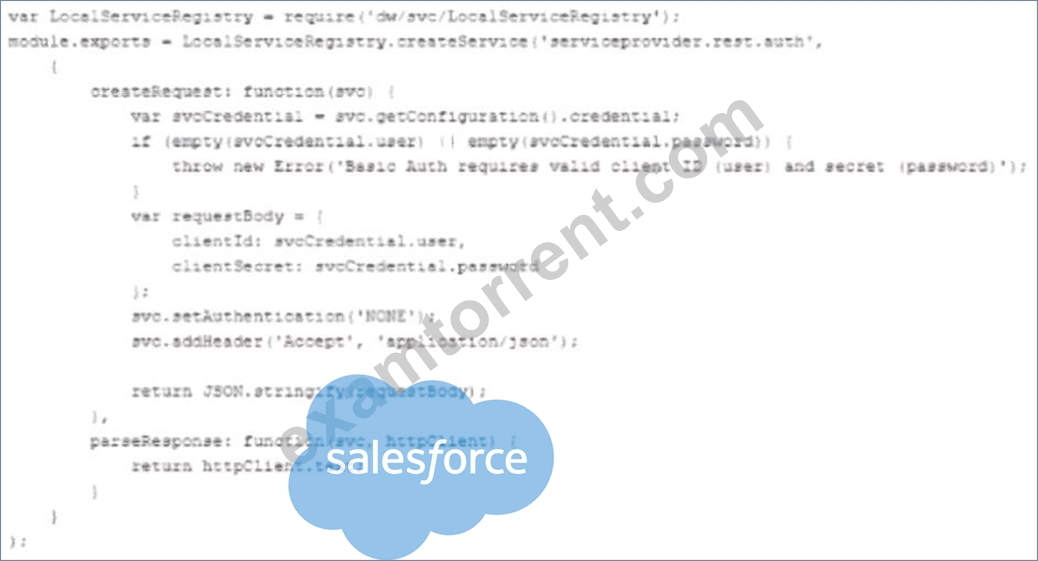
How does this code sample accomplish authentication to the service provider?
- A. By Issuing a Basic Auth request to the service provider.
- B. By performing a signed SOAP Auth request using a certificate.
- C. By disabling Basic Auth and executing the service authentication call.
- D. By wrapping the authentication service call with Basic Auth.
Answer: C
Explanation:
The code sample shows the creation of a service request to a third-party service provider, where the authentication method is explicitly set to 'NONE' using the line svc.setAuthentication("NONE");. This configuration implies that the request does not use Basic Authentication or any embedded credentials like client ID and secret in the HTTP headers for authentication purposes. Instead, it builds the authentication details into the request body, which suggests that the service expects credentials as part of the payload rather than as part of the standard authentication headers, thus effectively disabling Basic Auth for this transaction.
NEW QUESTION # 27
The Architect has been presented with a requirement from the business to implement a new LINK cartridge.
The current site is built on the Storefront Reference Architecture, and the LINK cartridge is certified for Pipelines and Controllers. On review, the Architect notes that the Jobs are all created in Pipelines.
How should the Architect implement that cartridge to make sure the required jobs runs property?
- A. The job Pipelines must be updated to work as custom job steps.
- B. The Job Pipelines must be updated to use SiteGenesis Controllers.
- C. The job Pipelines must be removed and recreated with scripts.
- D. The job Pipelines must be updated to useSFRA Controllers.
Answer: A
Explanation:
For integrating a LINK cartridge that is certified for pipelines and controllers into a system using the Storefront Reference Architecture (SFRA), which primarily uses scripts instead of the older pipeline technology, the architect should update the job pipelines to work as custom job steps. This approach allows the existing LINK cartridge functionalities to be maintained while making them compatible with the SFRA framework. Custom job steps enable more flexibility and the ability to leverage the full capabilities of SFRA, ensuring that the jobs run correctly within the newer architecture.
NEW QUESTION # 28
A new project for a Client will involve a few different Integrations to their middleware system resulting in four different web services. All will use the same credentials to the middleware. Each will have the same timeout, but will require a separate log file prefix.
How should the Architect set this up with the Service framework using a minimal set of configuration?
- A. Four Service Configurations. Four Service Profiles, Four Service Credentials
- B. One Service Configuration, Four Service Profiles, One Service Credential.
- C. Four Service Configurations. Four Service Profiles, One Service Credential
- D. Four Service Configurations. One Service Profile, One Service Credential.
Answer: D
Explanation:
For setting up multiple integrations that require the same credentials and timeout settings but need separate log file prefixes:
* Four Service Configurations are needed to specify the unique endpoint and other specifics for each of the four web services.
* One Service Profile can be used for all these configurations because they share the same timeout and other settings, optimizing the configuration process.
* One Service Credential is sufficient since all services authenticate with the same credentials, simplifying credential management and security handling.
This setup reduces redundancy and complexity in the service framework, ensuring a streamlined and efficient integration process while meeting all specified requirements.
NEW QUESTION # 29
A developer is validating the pipeline cache and noticed that the PDP page is very low cached. The one parameter is snowing the position on the product fisting page upon checking the site and code.
What should the developer adjust in order to improve the page cache hit ratio, keeping in mind that the client is Insisting on the parameter for their analytics?
- A. Rework the Implementation so the parameter is not passed In the URL and isread from the URL hash.
- B. Rework the Implementation so it doesn't depend on that parameter.
- C. Rework the implementation so it reads the parameter on client-side, passesit to the analytics and exclude It from cache parameters.
- D. Add the key to the cache exclude parameters.
Answer: D
NEW QUESTION # 30
A company that is a shoe-producer is doing Salesforce B2C Commerce implementation. In their Enterprise Resource Warning (ERP) system, the products are marked as being one of three types: boots, sandals, and sneakers. The business requirements based on the type are:
* The messaging on Product Detail page is different
* Customers are able to filler their Product Search Results
The customer's operations team asks about the format in which to send this value in the catalog.
Which data type should the Architect specify for this attribute In the Data Mapping document?
- A. A custom attribute of type enum-of-string (multiselect able value).
- B. A custom attribute type set-of-string containing multiple values.
- C. A custom attribute of type enum-of-string (single selectable value)
- D. A custom attribute of type string containing comma separated values.
Answer: C
Explanation:
For the shoe producer implementing Salesforce B2C Commerce, the attribute used to specify the type of shoes (boots, sandals, sneakers) should be set as a single selectable value, hence the use of an enum-of-string type. This data type allows for the selection of one option from a predefined list, which is ideal for cases where each product can only be categorized into one type. This ensures that data integrity is maintained while providing clear and distinct categorization that can easily be used for filtering on the Product Search Results page and for customized messaging on the Product Detail page.
NEW QUESTION # 31
A developer wants to import the data or different instances.
Which two types ofdata should the developer consider importing?
Choose 2 answers
- A. Catalog
- B. Metadata
- C. Sites configurations
- D. Services
- E. Customers
Answer: A,E
Explanation:
When importing data between instances, focusing on significant and impactful data types is essential:
* Option B (Catalog): Includes all product listings, descriptions, categorizations, and relationships. It's crucial for the eCommerce operation, directly affecting site navigation and customer experience.
* Option C (Customers): Customer data import is essential for maintaining continuity in customer relationships, access, and personalization across platforms.
These data types are fundamental to the functioning of an eCommerce site and ensure that essential operational data is consistent across different environments or platform migrations.
NEW QUESTION # 32
The Client identifies that a segment of customers need to see some products on the site that other customers should not be able to access. All products are maintained within one catalog but in separate categories. A custom attribute will be used on the Profile system object to identify customers that belong to this special segment. A customer group will be made that is qualified for by this Profile custom attribute. The storefront will be customized to include navigation to relevant categories for this customer group.
Unfortunately during technical review the Client points out that the business teams have raised a concern with maintenance and want to use a shared navigation within the catalog and not use separate categories.
Which item should the Architect suggest to efficiently fulfil this new requirement while maintaining scalability?
- A. Customize theStorefront to use separate storefront catalogs with the same navigation that If the customer Is In the customer group gets assign products appropriately.
- B. Customize the Storefront to use a hidden search refinement and modify the customer group to be qualified for by a new product custom attribute
- C. Customize the Storefront to modify the search result that if the user is in the customer group thenthe result includes those products appropriately.
- D. Customize the Storefront Co use a hidden search refinement that if the user Is In the customer group then the result Includes those products with a new custom attribute.
Answer: C
Explanation:
The optimal solution for this requirement is to modify the search results dynamically based on the user's customer group membership. This approach:
* Ensures that all users can navigate the same catalog and categories without seeing separate categories for special segments.
* Dynamically includes or excludes products from search results based on the user's membership in the special segment, effectively using existing catalog structures while personalizing product visibility.
* Maintains scalability by leveraging existing catalog and category infrastructure without needing additional custom attributes for navigation purposes.
This method aligns with best practices for creating personalized customer experiences in B2C Commerce without complicating catalog management.
NEW QUESTION # 33
A Client has automated builds that deploy the code; however, recent builds started failing with compilation issues, which are not reproducible in developer's environment.
Whetfirst step needs to be taken to identify and fix the issue?
- A. Verify the modules versions used to generate the code.
- B. Clean up build server work space and run job again.
- C. Recreate the job in the build server to verify compilation issues.
- D. Verify the generated JavaScript and CSS for the build.
Answer: B
Explanation:
When facing build failures that are not reproducible in developers' environments, a common and effective first step is to clean up the build server workspace (Answer A). This action clears any residual files, settings, or data that might be influencing the build process and causing discrepancies between local and server builds. By resetting the workspace to a clean state, it helps ensure that the build process is starting from a consistent base, potentially resolving issues caused by stale data or corrupted build artifacts. This step often resolves hidden configuration or environment-specific issues that are not immediately apparent in the code or module versions.
NEW QUESTION # 34
The Client is creating a new Storefront and their requirements include:
* ApplePay support
* Log -n through a standard OAuth2 social media account
* One Okie checkout process
* Ay B testing forpromotions
Which two items require technical documentation for customizing the Storefront Reference Architecture?
Choose 2 answers
- A. One Click checkout process
- B. log in through a standard OAuth2 social media account
- C. A/B testing forpromotions
- D. ApplePay support
Answer: A,B
Explanation:
For customizing the Storefront Reference Architecture to meet specific requirements, the following items would require detailed technical documentation:
* Option A (One Click checkout process): Implementing a one-click checkout process involves significant customization to streamline the checkout flow, potentially requiring integration with payment providers and modifications to the user session management.
* Option C (Log in through a standard OAuth2 social media account): Integrating OAuth2 for social media logins involves handling authentication tokens, user sessions, and potentially syncing user data with the B2C Commerce profiles, all of which require detailed security and integration documentation.
These customizations require careful planning and implementation to ensure they work seamlessly with existing Storefront Reference Architecture components and meet security standards.
NEW QUESTION # 35
The Client is Crowing and decided to migrate its ecommerce website to B2C Commerce. The Client provided the Architect with the f metrics for its existing website over the past 12 months and forecasted into the next year: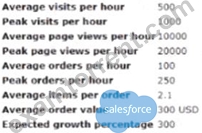
Noting these historical metrics and the forecasted growth of 300%, which load test targets meet best practices for testing the new B2C Commerce site?
- A. 15000 visits per hour, 300000 page views per hour, and 3750 orders per hour
- B. 1500 visits per hour, 30000 page views per hour, and 375 orders per hour
- C. 150000 visits per hour, 3000000 page views per hour, and 37500 orders per hour
- D. 3000 visits per hour, 60000 page views per hour, and 750 orders per hour
Answer: A
Explanation:
Considering the existing metrics and forecasted 300% growth, the appropriate load testing targets for the new B2C Commerce site would be:
* 15000 visits per hour: This figure is calculated by applying the expected growth to the peak visits per hour (1000 visits), resulting in 4000 visits. The choice of 15000 provides a higher buffer to accommodate unforeseen spikes in traffic.
* 300000 page views per hour: Similarly, this is scaled up from the peak page views per hour (20000) considering the growth, ensuring the site can handle high demand and interactions.
* 3750 orders per hour: This target is based on the peak orders per hour (250) with the growth applied, allowing testing of the system's ability to handle transactions under significant load.
These targets ensure that the system is robust enough to handle increased traffic and transactions without performance degradation, crucial for maintaining customer satisfaction and operational stability.
NEW QUESTION # 36
An Architect has been asked by the Business to integrate a newpayment LINK cartridge. As part of the integration, the Architect has created four new services to access various endpoints in the integration.
How can the Architect move the new services to Production when the integration is ready for launch?
- A. The new services must be manually exported from staging and Imported into Production.
- B. The new services will be moved to production with a Site Import.
- C. The new services will be moved to Production with a Code Replication.
- D. The new services will be moved to Production with a Data Replication.
Answer: C
Explanation:
For deploying new services related to a payment LINK cartridge to Production, the correct method is through Code Replication (D). This approach ensures that all new code changes, including the integration services, are consistently applied across different environments. Code replication covers deploying all changes made in code, scripts, and service configurations from a staging or development environment to the production environment. This process ensures that all new functionalities are tested in a controlled environment before being moved to production, reducing the risk of errors affecting the live site.
NEW QUESTION # 37
Given a website launched to production, the Architect can rely on several SFCC Business Manager tools that provide an automatic notification feature.
Which three tools have such a feature and do not require to be monitored manually?
Choose 3 answers
- A. Analytics Conversion Reports
- B. Quota Status
- C. Job Schedules
- D. Custom Log Settings
- E. Pipeline Profiler
Answer: B,C,E
Explanation:
The Salesforce B2C Commerce Business Manager tools that feature automatic notifications are:
* Option A (Job Schedules): Business Manager can send notifications based on job schedules, alerting users when a scheduled job has completed, failed, or met specific conditions. This feature helps in monitoring automated processes without manual oversight.
* Option D (Pipeline Profiler): This tool provides automatic notifications regarding the performance of different pipelines, allowing architects and developers to monitor site performance and troubleshoot issues proactively.
* Option E (Quota Status): Automatically notifies administrators when certain quotas are reached or exceeded, such as API call limits or data storage limits, which is crucial for maintaining site stability and performance.
These tools are essential for proactive site management, ensuring that administrators can address potential issues before they affect the site's operation.
NEW QUESTION # 38
A developer is checking for Cross Site Scripting (XSS) and found that the quick search is not escaped (allows inclusion of Javascript) in the following script:
How would the developer resolve this issue?
- A. Use <isprint value='${searchPhrase} encoding-'jsblock" />
- B. Use <toprint value="${searchPhrase}" />
- C. Replace 'with double Quote*
- D. Use <isprint value="${searchPhrase}* encoding-'jshtmr />
Answer: D
Explanation:
To resolve the issue of Cross Site Scripting (XSS) where the quick search is not escaped, the developer should use the <isprint> tag with the 'jshtml' encoding option (Answer B). This method ensures that any JavaScript included in the search phrase is properly escaped, preventing the execution of potentially malicious scripts.
The 'jshtml' encoding is specifically designed to encode text for HTML contexts where JavaScript is embedded, providing a secure way to handle user input in Salesforce B2C Commerce.
NEW QUESTION # 39
The Client has just acquired a new brand and wants toIntegrate the new brand s current ecommerce site into a current realm as a new site. The acquisition has its own Enterprise Resource Planning (ERP) system for product data and inventory. The new site will use the existing realm's Order Management System (OHS) and Customer Relationship Management (CRM) system.
What two requirements does the Architect need to keep in mind when creating the technical specification document?
Choose 2 answers
- A. A new order export job must be created to export orders.
- B. Anew product Import Job must be created to manage products.
- C. A new customer export Job must be created to export customers.
- D. A new inventory Import Job must be created to manage inventory.
Answer: B,D
Explanation:
When integrating a new brand's ecommerce site into an existing realm, the architect needs to ensure that product data and inventory from the new brand's Enterprise Resource Planning (ERP) system are correctly managed within the realm. Therefore, creating new import jobs for products (Answer B) and inventory (Answer C) is essential. These import jobs will facilitate the synchronization of the new brand's product catalog and inventory levels with the existing Order Management System (OMS) and Customer Relationship Management (CRM) systems of the realm. Such integration is crucial for maintaining up-to-date product and inventory information across the systems, ensuring seamless operations and data consistency.
NEW QUESTION # 40
The Client has implemented a different category/search layout for mobile and desktop. The code uses a session attribute called deviceType to choose the corresponding layout. This attribute it populated from the browser user agent. After this implementation they have run into these problems:
* Sometimes desktop pages are being served to both desktop and mobile customers.
* Sometimes mobile pages ate being served to both desktop and mobile customers.
The page has caching implementedthat depends; on promotions. SEC is very important and the site traffic is high.
Which solution should the Architect select to resolve the issue without impacting the existing requirements?
- A. Change the URL structure to include desktop and mobile as URL parameters to ensure different cached versions of the page
- B. Create customer groups for desktop and mobile users and empty promotions linked to these groups to ensure different cached versions of the page.
- C. Create customer groups for desktop and mobile users and uhremote includes based on these groups to render the mobile and desktop pages
- D. Disable caching for thesepages to ensure that the correct template is used to render the mobile and desktop pages.
Answer: A
Explanation:
To resolve the issue of incorrect page versions being served across different devices, changing the URL structure to include device-specific parameters can be highly effective. By adding parameters such as 'desktop' or 'mobile' to the URLs:
* The caching mechanism can differentiate between the content for different device types, thus caching and serving the correct version of the page according to the device type specified in the URL.
* This method allows for maintaining existing caching strategies linked to promotions and ensures that SEO is not adversely affected since the content remains the same per device type but is merely served through different URLs.
This approach addresses the core issue without requiring disabling of caching or reengineering existing promotional structures, hence preserving site performance and user experience.
NEW QUESTION # 41
......
Arch-303 Exam Practice Materials Collection: https://www.examtorrent.com/Arch-303-valid-vce-dumps.html
Get Latest and 100% Accurate Arch-303 Exam Questions: https://drive.google.com/open?id=12n7i3DIvHG4t0ZzcJ9vQdNNAJgSY47gQ
