

Latest [Feb 08, 2026] Realistic Verified 1z0-1057-25 Dumps
Pass Oracle 1z0-1057-25 Exam Updated 128 Questions
NEW QUESTION # 73
Your client is involved in automation control systems installation. Over the years, they have analyzed their total project spend on specific resource classes. They have identified that their cost spread distribution factor on a 10 spread point scale resembles:
0-4-10-11-14-13-10-4-0-0. Identify two ways to handle this kind of a spread on their budgets and forecasts. ( Choose two)
- A. Create a new spread curve or edit an existing spread curve to exactly match the spread points and attach to the resource class.
- B. Use the predefined S-Curve spread with small deviations on the spread points.
- C. Use the predefined Bell Curve spread with small deviations on the spread points.
- D. Create a new spread curve or edit an existing spread curve to exactly match the spread points and attach to a project template.
Answer: A,D
Explanation:
To handle a custom spread on budgets and forecasts, you can either create a new spread curve or edit an existing one to match the desired spread points. Then, you can attach the spread curve to a project template or a resource class, depending on whether you want to apply it to all projects using that template or all transactions using that resource class. Reference: https://docs.oracle.com/en/cloud/saas/project-portfolio- management/20c/oapfm/define-project-budgets-and-forecasts.html#OAPFM2355819
NEW QUESTION # 74
Your customer wants a project start date to cascade to the project tasks but does not want the finish date to be cascaded. Identify the default setup in a project template that can be used to enable this. (Choose the best answer.)
- A. Cascade change to the start date and the finish date.
- B. Cascade change to the finish date.
- C. Cascade change to the start date.
- D. Do not cascade date changes.
Answer: C
Explanation:
Reference https://docs.oracle.com/en/cloud/saas/project-portfolio-management/19b/oapfm/project-control- configuration-manage-financial-and-project-plan-types.html#OAPFM79055 Topic - Project Date Cascade Options Use the Cascade option choice list to determine whether your changes to project dates cascade to tasks.
Use the Basic Information region on the Edit Project Template page to select one of the following options:
* Do not cascade project date changes to tasks: Both start and finish dates are editable. However, you must ensure the following:
* The project start date is not later than the earliest task date.
* The project finish date is not earlier than the latest task date.
* Cascade project start date change to affected tasks: You can edit only the project start date.
* Cascade project finish date change to affected tasks: You can edit only the project finish date.
Do not cascade project date changes to tasks is the default value. You must select the cascade option each time you change the project dates, as your selection isn't saved for future date changes.
If you select to roll up planned dates for tasks or are using an external application for scheduling, then you can't modify the project start or finish dates.
NEW QUESTION # 75
Which three Cost Collection Flexfield core attributes can be derived during import if not explicitly entered in a transaction document? (Choose three.)
- A. Billable Flag
- B. Capitalizable Flag
- C. Funding Source
- D. Expenditure Type
- E. Work Type
Answer: A,B,D
Explanation:
The Cost Collection Flexfield is a descriptive flexfield that captures additional information about project costs. It has three core attributes that are required for every cost transaction: Billable Flag, Expenditure Type, and Capitalizable Flag. These attributes can be derived during import if not explicitly entered in a transaction document, based on various rules and sources such as expenditure type defaults, project type defaults, transaction source defaults, etc. Funding Source and Work Type are not core attributes of the Cost Collection Flexfield, but context-sensitive segments that can be optionally enabled for certain transaction sources or business units. These segments capture additional information about how the costs are funded or what type of work is performed. Reference: https://docs.oracle.com/en/cloud/saas/project-portfolio-management/20c/oapfm
/manage-project-costs.html#OAPFM2356141
NEW QUESTION # 76
Your customer has implemented Oracle Project Portfolio Management Cloud recently and they have hired new employees for their Professions Services business. These employees are set up in Oracle Human Capital Management Cloud, but the Project Administrators are unable to add them as resources in the Planning Resource Breakdown Structure.
What are three conditions for new employees to show up in the list? (Choose three.)
- A. All new employees created as persons must have an active supervisor.
- B. Current date is before the effective date of the resource, and you did not enable the "Include people with future-dated effective start dates" option during the search.
- C. All new employees created as persons must have an active project role.
- D. All new employees created as persons must be assigned to a department.
- E. All new employees created as persons must have an active assignment.
Answer: B,D,E
NEW QUESTION # 77
Your organization has been awarded a new contract based on which you are allowed to sell:
* Items not tracked in inventory
* Inventory items
* Services
Which contract structure would fulfill your requirement of item sales? (Choose the best answer.)
- A. Create two contract lines with a line type each of "sell intent, item, project-based' and "subscription, project-based, sell".
- B. Create two contract lines with a line type each of "product, project-based, sell agreement, standalone" and "sell intent, item, project-based".
- C. Create two contract lines with a line type each of "sell intent, free-form, project-based" and "sell intent, item, project-based".
- D. Create two contract lines with a line type each of "free-form, project-based buy agreement" and "bundle sell, project-based".
Answer: C
Explanation:
To sell items not tracked in inventory, inventory items, and services, you can create two contract lines with different line types. The line type of "sell intent, free-form, project-based" allows you to sell any item or service without specifying the item number or quantity. The line type of "sell intent, item, project-based" allows you to sell inventory items by specifying the item number and quantity. Both line types are project- based, meaning they are linked to a project and generate revenue based on project performance. Reference:
https://docs.oracle.com/en/cloud/saas/project-portfolio-management/20c/oapfm/manage-contracts.
html#OAPFM2355835
NEW QUESTION # 78
Which step within the functional setup manager helps you to move your verified setup data from the test environment to a production environment?
- A. Opting In
- B. Maintaining
- C. Setting Up
- D. Planning
- E. Deploying
Answer: E
Explanation:
The Deploying step within the functional setup manager helps you to move your verified setup data from the test environment to a production environment. This step allows you to export and import setup data across instances using spreadsheets or configuration packages. You can also compare and validate setup data across instances using reports and dashboards. Reference: https://docs.oracle.com/en/cloud/saas/project-portfolio- management/20c/oapfm/implement-project-financial-management-applications.html#OAPFM2356111
NEW QUESTION # 79
Your client uses Resource Breakdown Structures (RBS) and Resource Mapping to associate amounts to resources. After making some changes to the resources at project level, forecasts are regenerated. After reviewing the cost amounts associated with the resources, you suspect that the cost association does not match your client's expectations. Identify two valid rules based on which cost association works. (Choose two.)
- A. If there is only one level in RBS to which the transaction maps, the cost amounts are mapped to that level.
- B. If a transaction maps to more than one level, Oracle PPM Cloud sums the precedence numbers for all resource type in the branch and gives precedence to the resource element in the branch with the highest sum.
- C. If the sum of precedence numbers is the same for more than one branch, precedence is given to the branch with the lowest number at the lowest level.
- D. If one branch contains a user-defined resource type, precedence is given to the branch that contains a user-defined resource type.
Answer: A,C
Explanation:
Reference https://docs.oracle.com/cd/E37583_01/doc.1116/e22598/F458900AN13D82.htm How Resource Mapping Is Calculated You can track the cost impact of every resource that has been assigned to a project task and use the resource breakdown structure to view the breakdown of these costs. Oracle Fusion Projects associates the costs of the resources used for tasks with branches and levels in the resource breakdown structure. The process for determining the correct association is managed by rules of precedence.
Oracle Fusion Projects uses the following rules to associate cost amounts with resources:
* Select the lowest level in the resource breakdown structure to which a transaction can map.
* If there is only one level to which the transaction maps, the cost amounts are mapped to that level.
* If the transaction maps to more than one level, Oracle Fusion Projects sums the precedence numbers for all resource types in the branch and gives precedence to the resource element in the branch with the lowest sum.
* If more than one branch has the lowest precedence number at the lower level, the application uses the precedence number of the next level up.
* If the sum of precedence numbers is the same for more than one branch, precedence is given to the branch with the lowest number at the lowest level.
* If one branch contains a user-defined resource type, precedence is given to the branch that does not contain a user-defined resource type.
Note Oracle Fusion Projects gives more precedence to a lower precedence number. For example, a resource element with a precedence number of 1 is given precedence over a resource element with a precedence number of 10.
NEW QUESTION # 80
Your company creates a separate project for infrastructure services, so as to track these costs separately and then allocate to various projects that use the services of the infrastructure team. You want to allocate these costs by first attributing a fixed percentage of the source amount to each project and then spread it across tasks based on the actual labor hours charged to each task.
Which allocation basis method would you use to meet this requirement? (Choose the best answer.)
- A. spread evenly
- B. prorate
- C. target percentage and prorate
- D. target percentage and spread evenly
Answer: C
Explanation:
Ref: https://docs.oracle.com/en/cloud/saas/project-portfolio-management/19a/oapjc/allocate-project-costs.
html#OAPJC94831
* Spread Evenly
* The allocation rule divides the source pool amount equally among all the chargeable target tasks included in the rule. This is the most simple and direct basis method.
* Target Percentage and Spread Evenly
* Specify the percentage of the source pool that is required to allocate to each target line. The total specified target percentage must always equal 100 percent. The allocation rule calculates the amount to allocate to the target line, and then spreads the results evenly among the chargeable tasks.
* Prorate
* The allocation generation uses the attributes defined in the allocation rule to derive the rate at which the source pool amount is apportioned among the target projects and tasks. For this basis method, the allocation rule uses the basis attributes to apportion the source amount among all the tasks defined by the rule. The Prorate basis method provides precise control over how the rule distributes the source pool.
* Target Percentage and Prorate
* The allocation rule first uses the target percentage to calculate the amount to allocate to the line, and then apportions the results among all the tasks. The Target Percentage and Prorate basis method provides precise control over how the rule distributes the source pool.
NEW QUESTION # 81
Your organization has decided to enable the common accounting and project accounting periods option while defining business unit implementation options.
Where will you maintain the accounting period statuses if this option has been enabled?
- A. Project Foundation
- B. Project Costing
- C. General Ledger
- D. Subledger Accounting
Answer: A
NEW QUESTION # 82
Your customer has implemented Oracle Project Portfolio Management Cloud recently and they have hired new employees for their Professions Services business. These employees are set up in Oracle Human Capital Management Cloud, but the Project Administrators are unable to add them as resources in the Planning Resource Breakdown Structure.
What are three conditions for new employees to show up in the list? (Choose three.)
- A. All new employees created as persons must have an active supervisor.
- B. Current date is before the effective date of the resource, and you did not enable the "Include people with future-dated effective start dates" option during the search.
- C. All new employees created as persons must have an active project role.
- D. All new employees created as persons must be assigned to a department.
- E. All new employees created as persons must have an active assignment.
Answer: B,D,E
Explanation:
Ref: https://docs.oracle.com/en/cloud/saas/project-portfolio-management/19b/oapfm/project-foundation- configuration-define-project-resource-breakdown-structures.html#OAPFM180158_2 Why can't I find persons in the list of resources when I enter team members, planning resources, or person rate schedules?
You can't find persons in the list of resources when you enter team members, planning resources, or person rate schedules in the following situations:
* The administrator didn't assign a department while creating users. Persons must have an active assignment and be assigned to a department in Oracle Fusion Human Capital Management before they can be added as team members or entered as resources on the planning resource breakdown structure or person rate schedule.
* The resource isn't active in Oracle Fusion Human Capital Management because the current date is before the effective date of the resource. If you want to include persons who will start in the future, select the Include people with future-dated effective start dates option when you search for the person.
* Persons assigned as project managers aren't active as of the project start date.
* The assignment of the person is terminated, and an appropriate value isn't set for the number of days to display people with terminated assignments. You can set the profile value appropriately at the site profile level using the Specify Number of Days to Display People with Terminated Assignments task in the Setup and Maintenance work area.
NEW QUESTION # 83
Which two statements describe how the Resource Qualification Score is calculated?
- A. An individual's score is 100% if the resource request has a qualification with a specified proficiency and the resource has the qualification that meets the specified proficiency.
- B. An individual's score is 100% if the resource request has a qualification with a specified proficiency and the resource does not have the qualification.
- C. An individual's score is 100% if the resource request has a qualification, but no proficiency is specified, and the resource has the qualification.
- D. An individual's score is 100% if the resource request has a qualification with a specified proficiency and the resource has the qualification with a proficiency that is lower or higher than specified.
Answer: A,C
Explanation:
The Resource Qualification Score is a percentage that indicates how well an individual matches the qualifications required for a resource request. An individual's score is 100% if either of the following conditions are met:
* The resource request has a qualification, but no proficiency is specified, and the resource has the qualification. This means that any level of proficiency is acceptable for the qualification.
* The resource request has a qualification with a specified proficiency and the resource has the qualification that meets the specified proficiency. This means that the resource has the exact level of proficiency required for the qualification. An individual's score is not 100% if the resource request has a qualification with a specified proficiency and the resource does not have the qualification or has a different level of proficiency than required. In this case, the score is calculated based on how close the resource's proficiency is to the required proficiency. Reference: https://docs.oracle.com/en/cloud/saas
/project-portfolio-management/20c/oapfm/manage-project-resources.html#OAPFM2356001
NEW QUESTION # 84
Your customer has separate organizations to maintain indirect, capital, and billing types of projects.
Identify the two setups that can be used to fulfill this requirement. (Choose two.)
- A. Organization Tree
- B. Project Accounting Business Function
- C. Project Type
- D. Business Unit
- E. Project Organization Classification
Answer: A,E
NEW QUESTION # 85
You search for resources to fulfill a project resource request but are unable to proceed after receiving the following error message: "The search for resources cannot be completed because the project resource search index is not available. Contact your help desk." Identify the cause for this error message. (Choose the best answer.)
- A. The most recent update of the index finished successfully.
- B. The index is not in the process.
- C. The index has been built.
- D. The index is in the process of being updated.
Answer: D
Explanation:
Ref: https://docs.oracle.com/en/cloud/saas/project-portfolio-management/19a/fapfm/implementing-project- execution-management-applications.html#FAPFM1724547 Topic - Submitting the Process to Maintain Project Resource Search Index: Procedure Submit the Maintain Project Resource Search Index job set to update the resources that appear on the Search and Evaluate Resources page when a resource manager searches for resources to fulfill project resource requests. The job set consists of a set of processes that facilitate efficient and rapid searches for qualified resources.
Resource managers can't search for resources or view resource details if the search index isn't available for a project resource request with qualifications or keywords. For project resource requests without qualifications and keywords, resource managers can search for and evaluate resources based on resource availability even if the search index isn't current or available.
Caution: The search index isn't available if the Maintain Project Resource Search Index job set process fails, or while the process is running.
NEW QUESTION # 86
Your customer wants to calculate Estimate to Complete (ETC) as the difference between Current Planned Cost and Actual Cost. In Progress Settings, which option would you use in conjunction with the ETC method to meet this requirement? (Choose the best answer.)
- A. Cost
- B. Manual Entry
- C. Effort
- D. Remaining Plan
Answer: A
Explanation:
Reference https://ppm-help.saas.hpe.com/en/9.42/Help/Content/UG/PjMUG/view_pj_cost_data_costtab.htm Below is an example of the Financial Summary view on the Cost tab of the Project Overview page.
https://admhelp.microfocus.com/ppm/en/9.42/Help/Content/UG/PjMUG/images
/ProjectOverviewPage_CostTab.gif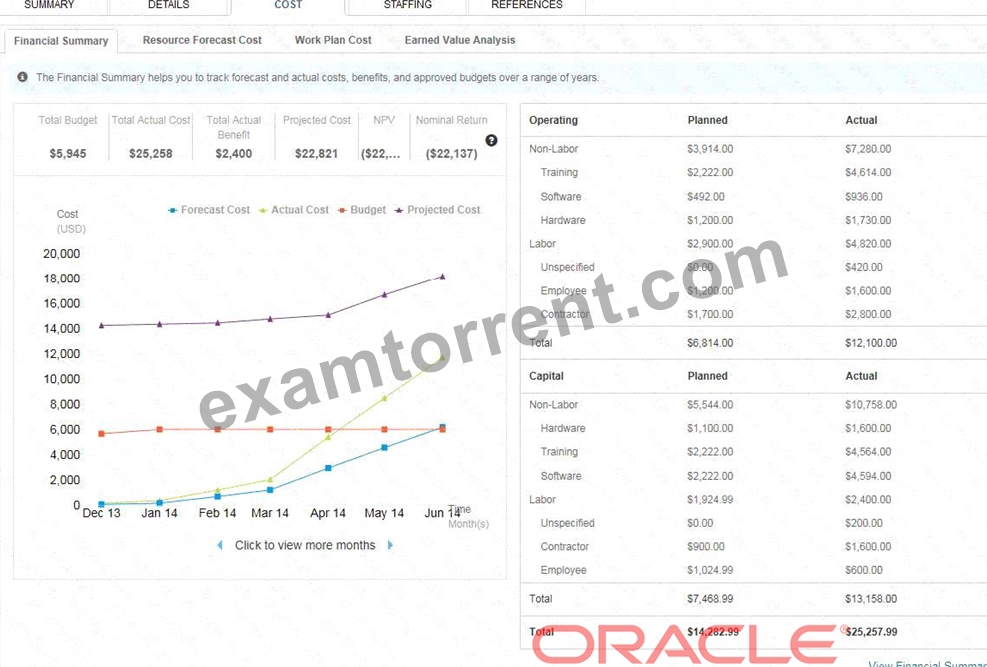
NEW QUESTION # 87
Your client organization has recently undergone a restructuring exercise that has resulted in the creation of new jobs. The Resource Breakdown Structure (RBS) was previously created with existing jobs, and now the new jobs have been added to the existing Resource Breakdown Structure.
Identify the correct statement about the RBS and new resources. (Choose the best answer.)
- A. If the "Allow resource changes at project level" option is set to No for the RBS, then the resources added to the Planning Resource Breakdown Structure are automatically available for use on the projects.
- B. If the "Allow resource changes at project level" option is set to Yes for the RBS, the new resources are available automatically at project level.
- C. If the "Allow resource changes at project level" option is enabled for the RBS, the new resources added at project level are automatically reflected in the RBS.
- D. If the "Allow resource changes at project level" option is set to No, the new resources and resource formats that are added to a Planning Resource Breakdown Structure for one project are not available for other projects.
Answer: A
Explanation:
Ref: https://docs.oracle.com/en/cloud/saas/project-portfolio-management/19a/fapfm/implementing-project-financial-management-applications.html#FAPFM969761
Topic - Entering Planning Resource Breakdown Structure Details
* Click Navigator > Setup and Maintenance, and search for the Manage Planning and Billing Resource Breakdown Structures task.
* Click the Manage Planning and Billing Resource Breakdown Structures link.
Use the Manage Planning and Billing Resource Breakdown Structures page to create new planning resource breakdown structures and to review existing planning and billing resource breakdown structures.
* Click the Create icon in the Planning Resource Breakdown Structures section.
* Use the Create Planning Resource Breakdown Structure: Basic Information page to provide basic resource breakdown structure information including the name, active dates, and project unit.
* Enter a planning resource breakdown structure name and select a date from which the resource breakdown structure is available for use.
* Optionally, provide a description and a date to which the planning resource breakdown structure is available for use.
* Select a project unit. Only projects created for the selected project unit can use this planning resource breakdown structure.
* If you want to allow project managers to add planning resources at the project level, then select the Allow resource changes at project level check box.
Tip: Changes at the project level don't move back to the parent planning resource breakdown structure.
Deselect this option to ensure all project using the planning resource breakdown structure use the same resources.
* Optionally, select a Job Set as a source of jobs for creating planning resources on your planning resource breakdown structure.
* Click Save.
NEW QUESTION # 88
Your organization has been using project class categories and codes for reporting purposes and is set up at the project level. You recently defined a new project type, Capital-Contract, and created new class categories named Build, Operate, and Transfer (BOT) and Build, Transfer, and Maintain (BTM), with class codes of Yes
/No. But on creation of a project, you are unable to associate these class categories and codes.
Identify two setups that are mandatory for these class categories and codes to be displayed. (Choose two.)
- A. Class categories should be assigned to business unit.
- B. Class categories should be assigned to project type.
- C. Class codes should be assigned to project unit.
- D. Class codes should be associated with a related set code.
Answer: B,D
Explanation:
Ref: https://docs.oracle.com/en/cloud/saas/project-portfolio-management/19a/oapfm/project-foundation- configuration-manage-project-types.html#OAPFM360164 Topic - Associating Project Types and Class Categories: Examples Project classifications group your projects according to categories and codes that you define. When you associate project classifications with project types, the classification is available for selection on projects with that project type.
Use any of the following methods to associate class categories with project types:
* Add a classification to the project type definition
For each classification that you associate with the project type, you can enable the Assign to All Projects option to automatically add the classification to the project definition for all new projects with the project type. When this option is enabled, all projects with this project type must be assigned a class code for the class category.
* Add a project type to the class category definition
* Enable the Assign to all Project Types option on the class category definition
NEW QUESTION # 89
Which three features are part of Oracle Fusion Functional Setup Manager?
- A. feature opt-in for a best fit configuration
- B. guided task list for end-to-end setup requirements
- C. modifying an existing implementation project task list by selecting more functional areas when needed
- D. export and import services for setup data migration between environments
- E. updating an implementation project task list by changing the opt-in configuration to suit the latest requirements
Answer: A,B,D
Explanation:
https://docs.oracle.com/en/cloud/saas/applications-common/r13-update17d/oafsm/applications-cloud-using-functional-setup-manager.pdf Functional Setup Manager offers the following:
* Standardized application configuration and setup experience
* Feature opt-in for a best fit configuration
* Flexible processes for managing setup:
# Setup by functional areas for an adopt-as-you-go approach
# Implementation projects to manage setup
# Upload file to enter setup data in bulk
* Guided task list for end-to-end setup requirements
* Export and import services for setup data migration between environments
* Comprehensive reporting on setup data
NEW QUESTION # 90
Which three are true of what you can do in the Project Requirements work area?
- A. Create project tasks for backlog items.
- B. Create an execution project.
- C. Create an implementation project.
- D. Organize backlog items by requirements.
- E. Manage your list of backlog items.
Answer: A,D,E
Explanation:
Ref: https://docs.oracle.com/en/cloud/saas/project-portfolio-management/19b/oapem/manage-project- requirements.html#OAPEM874365 Project Requirements: Explained Requirements enable you to capture your business needs. If you manage projects using the Agile development methodology, you start by identifying the high-level requirements and decomposing them further to manage the completion of work on the requirement.
You use the Project Requirements work area to:
* Organize backlog items by requirements
* Manage your list of backlog items
* Create project tasks for backlog items
NEW QUESTION # 91
Which three file-based data imports are available for use in Oracle Project Portfolio Management Cloud?
- A. Capital Rate Schedule
- B. Project Tasks
- C. Project Templates
- D. Project Budgets
- E. Project Billing Events
Answer: B,D,E
Explanation:
Ref: https://docs.oracle.com/en/cloud/saas/project-portfolio-management/19a/oefpp/toc.htm
NEW QUESTION # 92
What are three configuration items that you need to set up by using the Project Organizations functional area in Project Financial Management configurations? (Choose three.)
- A. Mange Project Types
- B. Mange Business Unit
- C. Manage Project Unit Organizations
- D. Manage Project Unit Options
- E. Manage Project Organization Classifications
Answer: C,D,E
Explanation:
Reference https://docs.oracle.com/en/cloud/saas/project-portfolio-management/19b/oapfm/define-project- organizations.html#OAPFM3094543 Topic - Manage Project Unit Organizations
NEW QUESTION # 93
Your customer wants to generate accounting based on project information associated with the transaction for all subledger transactions. Identify three subledger applications for which the project source is available for deriving accounts when configuring subledger accounting. (Choose three.)
- A. Purchasing
- B. Fixed Asset
- C. Receipt Accounting
- D. Payables
Answer: A,C,D
Explanation:
Ref: https://docs.oracle.com/en/cloud/saas/project-portfolio-management/19b/oapfm/project-costing- configuration-define-project-costing-integrations.html#OAPFM3094605 Topic - Deriving Projects-Related Accounts
NEW QUESTION # 94
Your organization has created an Enterprise Project Structure (EPS) and your executives review the overall project labor demand by using the EPS. Identify two correct statements about the periodic project labor demand. (Choose two.)
- A. Labor Demand FTE is calculated as Monthly Allocation hours divided by Monthly FTE hours, if a period is used as the basis for viewing labor demand.
- B. Labor Demand FTE is calculated as Quarterly Allocation hours divided by Quarterly FTE hours, if a quarter is used as the basis for viewing labor demand.
- C. Labor Demand FTE is calculated as Project Allocation hours divided by Project FTE hours, if project duration is used as the basis for viewing labor demand.
- D. Labor Demand FTE is calculated as Yearly Allocation hours divided by Yearly FTE hours, if a year is used as the basis for viewing labor demand.
Answer: B,D
Explanation:
Reference https://docs.oracle.com/cloud/farel10/projectcs_gs/OAPEM/OAPEM1461017.
htm#OAPEM1313472
Project Labor Demand: How It's Calculated
Project executives want to track the labor demand in projects in their organization. The Project Hierarchy Viewer provides project executives a hierarchical view of the enterprise project structure (EPS) along with the labor demand in terms of full-time equivalent (FTE).
Settings That Affect Project Labor Demand
Project application administrators must do the following to set up how project labor demand is calculated:
* Organize projects into hierarchical groups on the Manage Enterprise Project Structure page.
* Change the quarterly FTE hours for the organization on the Define Project Management Implementation Options page, if different from 520 hours.
Note: You can choose to view labor demand annually instead of quarterly. The Project Hierarchy Viewer uses the current date to determine which year or quarter to display.
How Project Labor Demand Is Calculated
The Project Hierarchy Viewer calculates project labor demand in the following manner:
* Spreads the allocation hours from the Manage Project Resources page evenly over the days that the resources are allocated to the project.
* Divides the quarterly project allocation hours by the quarterly FTE hours to get the labor demand.
* Rolls up the quarterly and annual labor demand up the hierarchy.
NEW QUESTION # 95
Your customer wants to see how quantity, cost, and revenue amounts are automatically distributed by using Spread Curve. Identify two period options that are available for this purpose. (Choose two.)
- A. Project Accounting Periods
- B. PA-GL Periods
- C. Accounting Periods
- D. Calendar Types
- E. PA Calendar
Answer: A,C
Explanation:
Reference https://fusionhelp.oracle.com/helpPortal/topic
/TopicId_P_87F467307D50416BE040D30A68816855
Spread curves let you distribute quantity, cost, and revenue amounts automatically across accounting or project accounting periods. You assign a spread curve to each resource class. Planning resources (in the planning resource breakdown structure) inherit the spread curve setting from the associated resource class.
You can change the spread curve for the planning resource and for any corresponding task assignments, or budget or forecast lines.
NEW QUESTION # 96
......
Get 2026 Updated Free Oracle 1z0-1057-25 Exam Questions and Answer: https://www.examtorrent.com/1z0-1057-25-valid-vce-dumps.html
1z0-1057-25 Dumps PDF and Test Engine Exam Questions: https://drive.google.com/open?id=15hHC_trkKYz6RZyQ4tIjoD6trRP_a5MF
