

Introduction-to-Biology Dumps with Practice Exam Questions Answers
Introduction-to-Biology by Courses and Certificates Actual Free Exam Practice Test
NEW QUESTION # 23
Which statement istrueofmeiosis?
- A. The daughter cells produced are diploid.
- B. A cell undergoestwo divisionsduring meiosis.
- C. Meiosis results in two daughter cells.
- D. The daughter cells produced are somatic cells.
Answer: B
NEW QUESTION # 24
Which comparison ofDNA and RNAis correct?
- A. DNA uses uracil; RNA uses thymine.
- B. DNA is a monomer; RNA is a polymer.
- C. DNA is single-stranded; RNA is double-stranded.
- D. DNA stores hereditary information; RNA is used to make proteins.
Answer: D
NEW QUESTION # 25
A gardener performs amonohybrid crosson twoheterozygousorange-fruited tomato plants. Therecessive phenotypeis yellow fruit. What percentage of offspring will produceyellowtomatoes?
- A. 50%
- B. 100%
- C. 25%
- D. 75%
Answer: C
NEW QUESTION # 26
Which statement istrueabout the organisms on the vertebrate cladogram?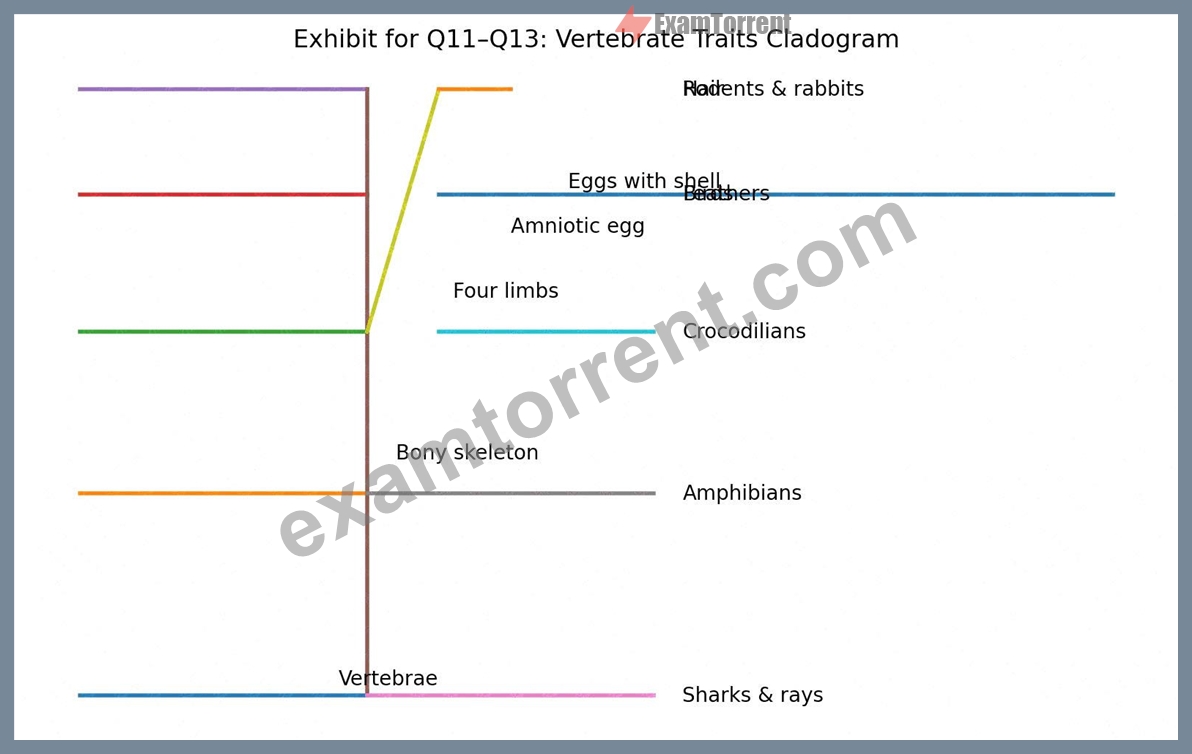
- A. Birds are the only species that produce eggs with shells.
- B. Sharks and rays have vertebrae but lack a bony skeleton.
- C. Only species with hair produce amniotic eggs.
- D. Amphibians are four-limbed species but lack a bony skeleton.
Answer: B
NEW QUESTION # 27
A wildlife biologist studies how lions and zebras interactandhow physical factors (temperature, water) affect them in the Serengeti. Which level of ecological organization is being studied?
- A. Population
- B. Biosphere
- C. Ecosystem
- D. Community
Answer: C
NEW QUESTION # 28
Thailand's rainforest area has decreased since the 1960s due to logging and land clearing for agriculture.
Which activity would continue to have a negative effect on biodiversity?
- A. Developing technologies that reduce chemical pollutants
- B. Increasing the use of renewable energy sources
- C. Increasing the use of sustainable technologies in Thailand
- D. Increasing the human population in Thailand
Answer: D
NEW QUESTION # 29
Which property of water is illustrated byinsects walking on water?
- A. Change in density when frozen
- B. Temperature stability
- C. Good solvent
- D. Cohesion
Answer: D
NEW QUESTION # 30
Ocean acidification dissolves calcium-based exoskeletons of purple sea urchins. Some individuals have a trait making their exterior more acid-resistant. If acidification increases, how is this population most likely to evolve?
- A. Acid-resistant exoskeletons become more common
- B. Less acid-resistant exoskeletons become more common
- C. Longer, more rigid spines become more common
- D. Shorter, more flexible spines become more common
Answer: A
NEW QUESTION # 31
Chocolate is produced when yeasts, bacteria, and molds break down sugars in cacao beanswithout oxygen, yielding alcohols/acids and a small amount of ATP. Which metabolic process is occurring?
- A. Photosynthesis
- B. Fermentation
- C. Aerobic respiration
- D. Cellular respiration
Answer: B
NEW QUESTION # 32
Coral reefs are built from calcium carbonate secretions of coral polyps and support diverse communities, but many are shrinking due to climate change. Which activity would have a negative impact on coral reef biodiversity?
- A. Increasing use of sustainable technologies
- B. Increasing use of fossil fuels
- C. Increasing the use of renewable energy sources
- D. Developing technologies that reduce pollutants
Answer: B
NEW QUESTION # 33 
Refer to theSpecies A-D Cladogram (Node X). What doesNode Xrepresent?
- A. The point where species B, C, and D diverged from species A
- B. The common ancestor of species A, B, C, and D
- C. The point at which species C and D diverged
- D. The point at which species C and D diverged from species B
Answer: C
NEW QUESTION # 34
How isDNA organized during prophase, and why?
- A. Condensed, which makes it easier to move
- B. Organized into paired chromatids to keep it lined up at the center
- C. Uncondensed because it needs to be lined up at the center
- D. Uncondensed because it needs to move toward the poles
Answer: A
NEW QUESTION # 35
What is the process in which microbes convert glucose,in the absence of oxygen, intotwo ethanolmolecules andtwo carbon dioxidemolecules?
- A. Aerobic oxidation
- B. Carbon fixation
- C. Fermentation
- D. Phosphorylation
Answer: C
NEW QUESTION # 36
A primary consumer (e.g., an insect) derives energy from which level of the food chain?
- A. Secondary consumer
- B. Primary consumer
- C. Producers
- D. Carnivore
Answer: C
NEW QUESTION # 37
How doesgene flowtypically affect therecipientpopulation?
- A. Increases genetic variability
- B. Exacerbates genetic drift
- C. Increases random mating
- D. Exacerbates natural selection
Answer: A
NEW QUESTION # 38
A species of fish can have dominantred fins (R)or recessivewhite fins (r), and dominantlong fins (L)or recessiveshort fins (l). In adihybrid cross, each parent isheterozygousfor both traits (RrLl × RrLl). How manydifferent gamete genotypescan each parent produce?
- A. 0
- B. 1
- C. 2
- D. 3
Answer: A
NEW QUESTION # 39
Through which process does information flow fromRNA to protein?
- A. Transposition
- B. Transcription
- C. Translation
- D. Transformation
Answer: C
NEW QUESTION # 40
What is a necessaryinputto begin the process ofcellular respiration?
- A. Water
- B. Carbon dioxide
- C. Sugar
- D. ATP
Answer: C
NEW QUESTION # 41
Agroup of lionsthat preys on deer constitutes which ecological level?
- A. Biome
- B. Community
- C. Ecosystem
- D. Population
Answer: D
NEW QUESTION # 42
Which organisms havefour limbsand produceeggs that are not amniotic?
- A. Crocodilians
- B. Birds
- C. Amphibians
- D. Sharks and rays
Answer: C
NEW QUESTION # 43
Refer to the diagram "Arctic Marine System Components."
Which components in the figure areabiotic?
- A. Fish and zooplankton
- B. Organic deposits, lobster, and polar bear
- C. Sunlight, organic deposits, and phytoplankton
- D. Sea ice and CO#
Answer: D
NEW QUESTION # 44
Molecules withhydrophilic headsandhydrophobic tailsform round structures with tails facing inward when placed in water. What role do such molecules play in a cell?
- A. Store energy
- B. Store genetic information
- C. Catalyze chemical reactions
- D. Form membranes
Answer: D
NEW QUESTION # 45
A molecule doesnotdissolve in water and consists ofglycerol covalently bound to three fatty acid tails.
What is the primary function of this molecule?
- A. Energy storage
- B. Genetic information storage
- C. Cell communication
- D. Catalysis of chemical reactions
Answer: A
NEW QUESTION # 46
A gene sequenceCGCATACGGTACencodes a peptide (Arg-Ile-Arg-Tyr). A mutation inserts aGafter the secondC. How will this most likely affect the phenotype?
- A. No effect; only the second amino acid changes
- B. Affects phenotype; only the first amino acid changes
- C. No effect; protein will be identical
- D. Affects phenotype; all amino acids after the first will change (frameshift)
Answer: D
NEW QUESTION # 47
......
Free Courses and Certificates Introduction-to-Biology Exam Question: https://www.examtorrent.com/Introduction-to-Biology-valid-vce-dumps.html
Introduction-to-Biology dumps & Courses and Certificates sure practice dumps: https://drive.google.com/open?id=1lrvzPsql30ecSymDbHDqrpDajIuAGm3L
