

[Jan-2022 Newly Released] 71300X Exam Questions For You To Pass
Avaya 71300X Exam: Basic Questions With Answers
NEW QUESTION 23
In which location is the AAMS URI '[email protected]' configured?
- A. Elements > Breeze > Configuration > HTTP Security and as a Regular Expression
- B. Home > Elements > Breeze > Configuration > Avaya Aura Media Server and as a Regular Expression
- C. Home > Elements > Breeze > Configuration > Avaya Aura Media Server and as a Dial Pattern
- D. Elements > Breeze > Configuration > HTTP Security and as a Dial Pattern
Answer: B
Explanation:
Explanation
Creating the Avaya Aura Media Server Routing Pattern
Procedure
1. On System Manager, click Elements > Routing > Routing Policies.
2. Click New.
3. Type a Name for the Routing Policy.
4. From the SIP Entity as Destination field, click Select.
5. Select the Avaya Aura
Media Server SIP Entity that you created.
Select the Local Host Name FQDN SIP Entity if you are using High Availability for the Avaya Aura Media Server routing.
6. Click Commit.
7. Navigate to Home > Elements > Routing > Regular Expressions and click New.
8. In the Pattern field, type ce-msml@<sip-domain>.*
This sip-domain value must match:
* The SIP domain that you entered in the Home > Elements > Routing > Domains page.
* The default SIP domain that you entered on the Avaya BreezeTM Cluster Administration page.
9. Click Commit
https://downloads.avaya.com/css/P8/documents/101014426
References: Deploying Avaya Breeze, Release 3.1, (September 2016), page 55
NEW QUESTION 24
From a remote worker's SIP Endpoint connected via Mobile Workspace, which tool is used to trace the successful way through Avaya Session Border Controller for Enterprise (SBCE) of an Invite message?
- A. traceSBC
- B. traceMW
- C. traceSM
- D. traceRT
Answer: C
Explanation:
Explanation
traceSM is an interactive perl script that allows an administrator to capture, view, and save call processing activity on a Session Manager. While not as powerful or versatile as wireshark, traceSM is absolutely essential when it comes to working with Avaya SIP. First off, it allows you to view SIP messages even if they have been encrypted with TLS.
NEW QUESTION 25
In the context of Avaya Aura Presence Services 7.x, what is a Fetcher?
- A. It is a watcher that is subscribing to current and future presentity information from another user.
- B. It is a kind of watcher that requests a one-time view of the user's current presentity information, but does not get future presentity information for a user.
- C. It is the presence information about a user that the system reports.
- D. It is a user whose devices are sending status or presentity information on his behalf using a Publish message regarding his communication status.
Answer: B
Explanation:
Explanation
Fetchers pull the value of presence information for a specific presentity from the presence service. If a fetcher is fetching information on a regular basis, it is called a poller. Subscribers, on the other hand, subscribe to presentity information on the presence service.
NEW QUESTION 26
To set Timers, URI Manipulation, and Header Manipulation that the Avaya Session Border Controller for Enterprise (SBCE) will use when signaling to the far-end server; a profile like "avaya-ru" is provided by default.
When configuring the Server Configuration, you must link to which type of Global profile?
- A. Routing
- B. Server Interworking
- C. Topology Hiding
- D. Signaling
Answer: B
Explanation:
Explanation
The standard Avaya profile "avaya-ru" is cloned for the Call Server Interworking Profile.
The Interworking function of the Global Profiles feature enables the SBCE to function in an enterprise VoIP network using different SIP protocols.
References: Avaya Aura Session Border Controller Enterprise Implementation and Maintenance (2012), page
339
NEW QUESTION 27
The WebRTC snap-in needs to be loaded on which of Avaya BreezeTM cluster?
- A. Work Assignment EDP Cluster
- B. General Purpose EDP Cluster
- C. Context Store EDP Cluster
- D. Core Platform EDP Cluster
Answer: D
Explanation:
Explanation
A cluster profile is a pre-loaded template that contains cluster attributes.
The Core Platform cluster profile: A closed cluster that supports up to 10 Avaya Breeze servers.
NEW QUESTION 28
The provisioning script automatically runs as part of the first boot-up of the Avaya Session Border Controller for Enterprise (SBCE). During this process you assign the Management IP address to the SBCE. You browse to the Element Management System (EMS) to continue to install the SBCE.
On the System Management > Devices web page, which status does the SBCE display before the Install link is clicked?
- A. Registered
- B. Provisioned
- C. Ready
- D. Commissioned
Answer: A
Explanation:
Explanation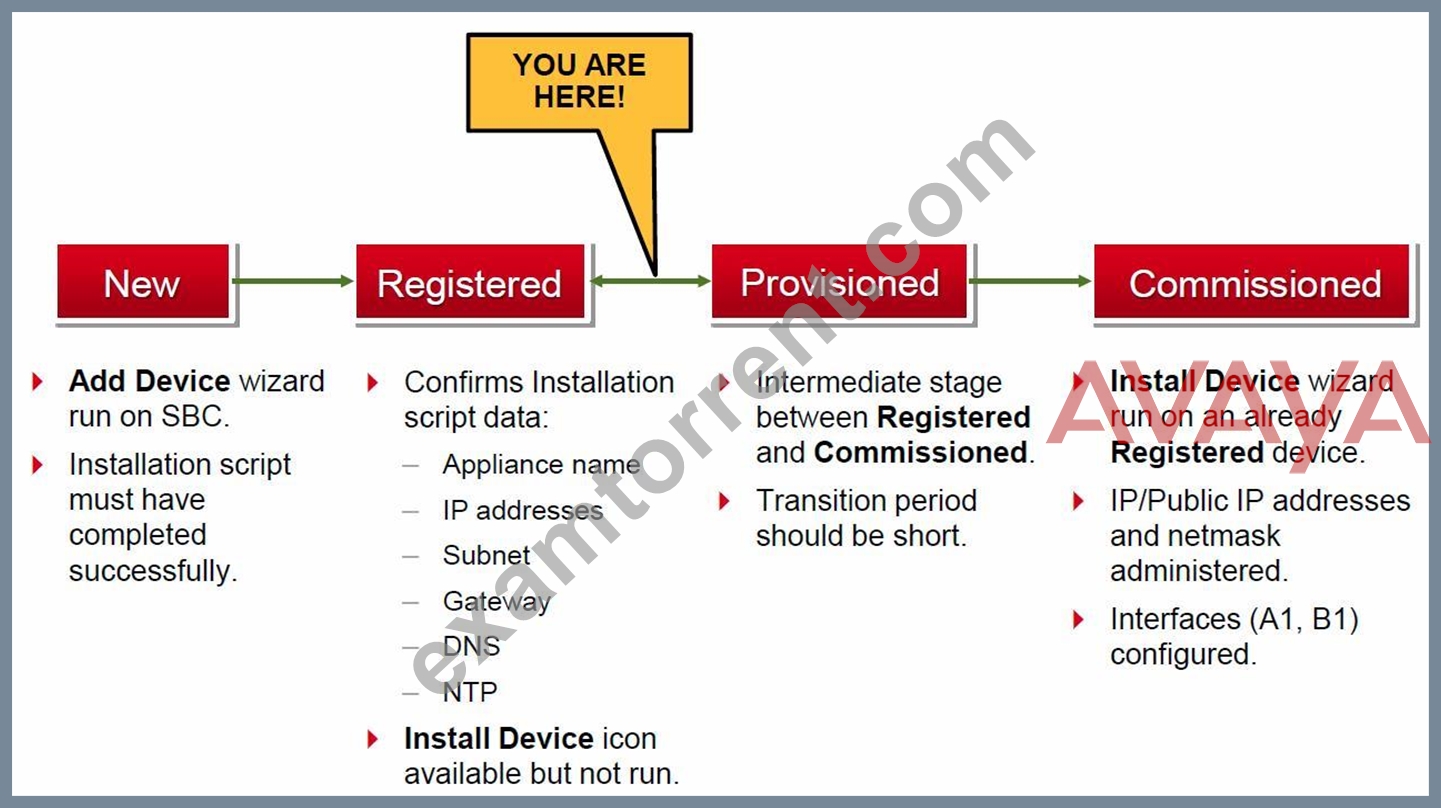
References: Avaya Aura Session Border Controller Enterprise (2012), page 201
NEW QUESTION 29
A company is deploying Avaya Session Border Controller for Enterprise (SBCE) to support SIP trunking.
What is the minimum number of IP-addresses they need to assign to the private and public Network Interface Cards (NICs)?
- A. One address is assigned to the private NIC and one address is assigned to the public NIC.
- B. Two addresses are assigned to the private NIC and two addresses are assigned to the public NIC.
- C. One address is assigned to the private NIC and two addresses are assigned to the public NIC.
- D. Two addresses are assigned to the private NIC and one address is assigned to the public NIC.
Answer: A
Explanation:
Explanation
Example configuration: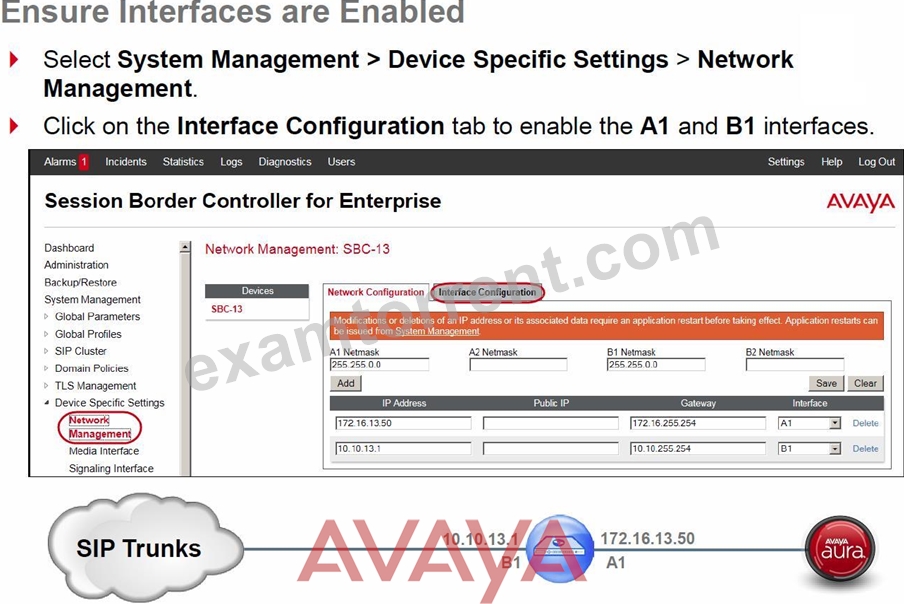
References: Avaya Aura Session Border Controller Enterprise Implementation and Maintenance (2012), page
305
NEW QUESTION 30
To route calls to Avaya Aura Messaging (AAM), which routing strategy is used by Avaya Aura Session Manager (SM)?
- A. Automatic Route Selection (ARS)
- B. Network Routing Policies (NRP)
- C. Registry Routing
- D. Automatic Alternate Routing (AAR)
Answer: B
Explanation:
Explanation
Routing policies describe the conditions under which Session Manager will route calls between Communication Manager and Avaya Aura Messaging.
References: Application Notes for Configuring Avaya Aura Messaging 6.1 as a Voice Messaging Solution for Avaya Aura Communication Manager 6.0.1 Feature & Evolution Server Using SIP Trunks and Avaya Aura Session Manager 6.1 -Issue 1.0, page 25
https://www.devconnectprogram.com/fileMedia/download/08ad7375-7c2e-4767-929f-15f4e8130a0d
NEW QUESTION 31
In Avaya Aura Messaging 6.3, which statement is true about Avaya Aura Messaging (AAM) capacities of a system utilizing the Standard Capacity (non-High Capacity) Message Store template?
- A. One Message Store Server supports up to 600 user mailboxes and you can have 5 active + 1 Redundant Application Servers in a cluster.
- B. One Message Store Server supports up to 60000 user mailboxes and you can have 5 active + 1 Redundant Application Servers in a cluster.
- C. One Message Store Server supports up to 6000 user mailboxes and you can have 3 active + 1 Redundant Application Servers in a cluster.
- D. One Message Store Server supports up to 1000 user mailboxes and you can have 3 active + 1 Redundant Application Servers in a cluster.
Answer: C
Explanation:
Explanation
Dedicated AxC/Directory server: A physical server that manages notification capabilities and the LDAP database and provides communications between application servers and the thirdparty storage server. This server also stores user properties and name and greeting recordings.
Not all configurations require a dedicated AxC/Directory server because the AxC/Directory role runs on the Avaya-provided message store. You only need a dedicated AxC/Directory server for:
References: Avaya Aura Messaging Overview and Specification, Release 6.3.2 (January 2015) , page 20
https://downloads.avaya.com/css/P8/documents/101004642
NEW QUESTION 32
If more than one Avaya BreezeTM node is available in the cluster, which statement about redundancy and load-balancing is true?
- A. The list of all Avaya BreezeTM nodes SM100 IP addresses must be configured in the client.
- B. IM clients point to the Leader Avaya BreezeTM node SM100 IP address which redirects the clients to a particular Avaya BreezeTM node based on load-balancing policy.
- C. The Cluster IP address is not used for Presence Services in 7.0. IM clients configure a FQDN instead of IP address which is resolved by a DNS server to all Avaya BreezeTM nodes in the cluster.
- D. IM clients point to any Avaya BreezeTM node SM100 IP address. The client is dynamically informed of alternate Avaya BreezeTM nodes in the cluster.
Answer: B
Explanation:
Explanation
Enable load balancing for a cluster if you want to scale the HTTP services without targeting a particular Avaya BreezeTM server. All the requests are sent to the cluster IP address. When you enable load balancing, two Avaya BreezeTM servers are chosen as the active and standby load balancing servers. The active load balancer distributes the HTTP requests to all the other servers in the cluster in a round robin fashion.
References: Administering Avaya Breeze, Release 3.1 (May 2016), page 16
https://downloads.avaya.com/css/P8/documents/101014143
NEW QUESTION 33
When configuring a SIP Entity for Avaya Aura Messaging (AAM) in Avaya Aura System Manager, which Type of SIP entity needs to be selected?
- A. Other
- B. Messaging
- C. Communication Manager Messaging
- D. Avaya Aura Messaging
Answer: A
Explanation:
Explanation
Define SIP Entity
Expand Elements, Routing and select SIP Entities from the left navigation menu.
Click New (not shown). In the General section, enter the following values and use default values for remaining fields.
* Name: Enter an identifier for the SIP Entity
* FQDN or IP Address: Enter IP address of Avaya Aura Messaging.
* Type: Select "Other"
Etc.
References: Application Notes for Configuring Avaya Aura Messaging 6.1 as a Voice Messaging Solution for Avaya Aura Communication Manager 6.0.1 Feature & Evolution Server Using SIP Trunks and Avaya Aura Session Manager 6.1 - Issue 1.0 , page 22
https://www.devconnectprogram.com/fileMedia/download/08ad7375-7c2e-4767-929f-15f4e8130a0d
NEW QUESTION 34
To which other component does the Avaya Aura Application Enablement Services (AES) Switch Connections connect?
- A. Avaya Aura Media Server (AAMS) using H.323
- B. Avaya Aura Session Manager (SM) using SIP
- C. Avaya Aura Communications Manager (CM) using SIP
- D. Avaya Aura Communications Manager (CM) using H.323
Answer: D
Explanation:
Explanation
Adding a switch connection
The procedure include the following steps:
1.From the AE Services Management Console main menu, select Communication Manager Interface > Switch Connections.
2. On the Switch Connections page, in the Add Connection field, type a switch connection name (for example Switch1) For the Secure H323 Connection check box, do one of the following:
* For Communication Manager6.3.6 or later and TLS for the H.323 Signaling Channel (normally associated with FIPS Mode), select the Secure H323 Connection check box.
* For any previous release of Communication Manager without TLS for the H.323 Signaling Channel, uncheck the Secure H323 Connection check box.
Etc.
References: Avaya Aura Application Enablement Services Administration and Maintenance Guide, page 73
https://downloads.avaya.com/css/P8/documents/100171737
NEW QUESTION 35
The Avaya WebRTC solution uses the web intensively to make media calls from a standard web browser in the internet, into internal and secure communication premises in the enterprise.
Which statement about security between the Enterprise-edge and those standard Web browsers in the internet is true?
- A. No trust relationship exists between enterprise edge security and web browsers; therefore, the security strategy is based on an Authorization Token instead.
- B. WebRTC only works within the Enterprise network. External Web Browsers must connect through an Avaya Session Border Controller for Enterprise (SBCE) via a SIP trunk.
- C. There must be a VPN connection between the Web Browser and the Enterprise-edge to build a WebRTC link.
- D. A trust relationship based on certificates must be built to make WebRTC work.
Answer: A
Explanation:
Explanation
Validation of the authorization token.
The WebRTC Snap-in will validate the authorization token created and encrypted by the web server. If the snap-in can decrypt the token and ensure that the time stamp is valid, it knows that the incoming HTTP request is valid. The time stamp will usually be short lived; on the order of 5-10seconds to protect against reply attacks.
References: Avaya WebRTC Snap-in Reference, Release 3.1 (May 2016), page 27
https://downloads.avaya.com/css/P8/documents/101013939
NEW QUESTION 36
To allow trust between Avaya Aura System Manager (SMGR) and Avaya Aura Messaging (AAM), there is a password set when you add the Trusted Server on AAM. This password must match with the password also configured in SMGR.
Which statement about the password in SMGR is true?
- A. It needs to match the Attributes of the Messaging Managed Element in the Inventory.
- B. It needs to match the root password used to login to SMGR command line.
- C. It needs to match the Enrollment Password.
- D. It needs to match the admin password used to login to SMGR using a web browser.
Answer: A
Explanation:
Explanation
Configuring Messaging in the normal operational mode
Before you begin
* Add both the primary and secondary servers as Trusted Servers in the Messaging system.
* Update the Login, Password, and Confirm Password fields with the appropriate trusted server defined on the Messaging system.
Procedure
1. Log on to the Messaging system that System Manager manages.2. Add the secondary System Manager server as Trusted Servers in the Messaging system.
3. Log on to the secondary System Manager server.
4. On the System Manager web console, click Services > Inventory.
5. In the left navigation pane, click Manage Elements.
6. On the Manage Elements page, select the Messaging system that you want to change to the secondary System Manager server.
7. Click Edit.
8. On the Attributes tab, fill the Login, Password, and Confirm Password fields with the corresponding name and password of the Messaging trusted server.
9. Click Commit.
10. Click Inventory > Synchronization > Messaging System, and select the required Messaging element.
11. Click Now.
The secondary System Manager server retrieves all data from Messaging and is now ready to administer and manage Messaging.
References: Administering Avaya Aura System Manager for Release 6.3.11 and later, Release 6.3, Issue 8 (November 2016), page 104
https://downloads.avaya.com/css/P8/documents/101008185
NEW QUESTION 37
By default, which Codec does Avaya Aura Messaging (AAM) support?
- A. G.711
- B. G.726
- C. G.722
- D. G.729
Answer: A
Explanation:
Explanation
You must configure the Messaging system to use the G.711 encoding format.
Note: The G.711 format provides the highest audio quality especially when voice networks use multiple encodings and decodings. Avaya requires that you use the G.711 encoding format in Messaging systems that support TTY devices.
The G.711 encoding format uses a higher encoding rate than GSM. The G.711 encoding format therefore produces larger files and requires more storage space for messages. Messaging provides customers with adequate storage space for message playback and networking.
References: Administering Avaya Aura Messaging, Release 6.2 Issue 2.2 (December 2013) , page 201
https://downloads.avaya.com/css/P8/documents/100172127
NEW QUESTION 38
Which four kinds of services does the TSAPI standard provide for third-party call control over Avaya Aura Communication Manager (CM)? (Choose four.)
- A. invoking CM features
- B. adding new feature buttons to agent sets
- C. performing a remote reboot to the CM server
- D. completing the routing of incoming calls
- E. controlling specific calls or stations
- F. receiving notifications of events
Answer: A,D,E,F
Explanation:
Explanation
A: The services in the Event Report group provide a client application with the reports of events that cause a change in the state of a call, a connection, or a device.
B: The services in the call control group enable a telephony client application to control a call or connection on Communication Manager. Typical uses of these services are:
placing calls from a device
controlling a connection for a single call.
C: The services in the query group allow a client to query device features and static attributes of a Communication Manager device.
E: The services in the routing group allow Communication Manager to request and receive routing instructions for a call from a client application.
References: Avaya Aura Application Enablement Services TSAPI for Avaya Communication Manager Programmer's Reference Release 6.1, page 128
https://downloads.avaya.com/css/P8/documents/100141354
NEW QUESTION 39
What should be verified before running the initTM -f command on the Command Line Interface of Avaya BreezeTM platform (formerly known as Engagement Development Platform (EDP))?
- A. Verify that Avaya BreezeTM is licensed.
- B. Verify that Avaya BreezeTM is configured as a Managed Element in Avaya Aura System Manager.
- C. Verify that an enrollment password is configured on System Manager and that it has not expired.
- D. Verify that a valid Certificate is installed on the Avaya BreezeTM instance.
Answer: C
Explanation:
Explanation
See step 8 and step 9 below.
Repairing replication between Avaya BreezeTM and System Manager
Procedure
1. On the System Manager web console, navigate to Services > Replication.
2. In Replica Group column, click CollaborationEnvironment_3.1.
3. In Replica Node Host Name column, locate Avaya BreezeTM.
4. Verify that the status of the Synchronization Status field is green. If not, go to Step 5.
5. If Presence Services Snap-in has been deployed, in the Product column, verify that both Avaya BreezeTM and Presence Services are displayed.
6. Select Avaya BreezeTM, and click Repair.
7. After 2-15 minutes, verify that the status of the Synchronization Status field is green. If not, go to Step 8.
8. Verify that Enrollment Password is not expired.
a. Navigate to Services > Security.
b. In the navigation pane, click Certificates > Enrollment Password.
9. If the Enrollment Password is expired:
a. Enter a password, and click Commit.
It is highly recommended that the same password must be used. Otherwise, Avaya BreezeTM and Presence Services must be re-administered, because System Manager Enrollment Password was configured during deployment of Avaya BreezeTM.
b. Open an SSH session to the Avaya BreezeTM Management Module IP address as sroot.
c. On the command line interface, enter initTM -f.
d. When prompted for the enrollment password, enter the password that you provided in Step 9a.
e. Repeat Step 1 to Step 6.
References: Avaya Aura Presence Services Snap-in Reference, Release 7.0.1 (December 2016), page 223
https://downloads.avaya.com/css/P8/documents/101013646
NEW QUESTION 40
What are the three components of Avaya Aura Messaging (AAM)? (Choose three.)
- A. Messaging Store
- B. Application Server
- C. Messaging Distributor
- D. SM100 Module
- E. AxC/Directory
Answer: A,B,E
Explanation:
Explanation
The AXC connector is always co-resident with the Avaya message store.
References: Administering Avaya Aura Messaging Release 6.2, Issue 2.2 (December 2013)
https://downloads.avaya.com/css/P8/documents/100172127
NEW QUESTION 41
In Avaya Session Border Controller for Enterprise (SBCE) 7.x, which two configuration screens must be configured for Personal Profile Management (PPM) to be successfully downloaded to an Avaya SIP Telephone (AST)? (Choose two.)
- A. File Transfer
- B. PPM Services Mapping Profile
- C. Reverse Proxy
- D. Application Relay
Answer: B,D
Explanation:
Explanation
B: Application relays function as port forwards. Different clients require different application relays.
A: An Avaya SIP phone downloads and processes a configuration file, sends out a slew of SUBSCRIBE messages, and uses something called Personal Profile Manager (PPM).
Note: The PPM is a software module that runs as part of an Avaya Session Manager. It consists of a series of web services that phones use to retrieve and manage SIP related user data.
References:
https://andrewjprokop.wordpress.com/2014/03/28/understanding-avayas-personal-profile-manager-ppm/
https://downloads.avaya.com/css/P8/documents/101028355
NEW QUESTION 42
What are three ways of accessing Avaya Aura Application Enablement Services (AES) to perform administration? (Choose three.)
- A. with remote access using Rlogin
- B. with remote access using SSH
- C. with an Open X.11 terminal window
- D. with local access using a system console
- E. with web access
Answer: B,D,E
Explanation:
Explanation
B: You can use a Web browser to access the Application Enablement Services Management Console (AE Services Management Console).
DE: Administrators can access the AE Services Linux shell (command prompt) either locally using a system console or remotely using a secure shell (ssh) client. This access method applies primarily to AE Services Technicians (craft users) who perform specific tasks, such as viewing trace logs, installing patches, and so forth.
References: Avaya Aura Application Enablement Services Administration and Maintenance Guide , page 52
https://downloads.avaya.com/css/P8/documents/100171737
NEW QUESTION 43
Which three functionalities does WebRTC provide? (Choose three.)
- A. real-time audio and video conferencing
- B. adds click-to-call capabilities from a web application to an Avaya endpoint
- C. NAT / Firewall Traversal
- D. Internet-friendly codecs and Privacy
Answer: A,B,C
Explanation:
Explanation
* One of the primary differentiating features for the WebRTC Snap-in is that the web application handles authentication and authorization of calls. This includes the capability to assert a calling user's phone number and restrict the numbers that can be called.
* The Avaya SBCE enables secure firewall traversal for HTTP and SRTP packets, facilitates sending DTLS to provide secured key exchange for the SRTP flow, and takes care of all security requirements mentioned in the TURN protocol for the solution.
* WebRTC can be a game changer for enterprise communications and customer engagement. Enterprises can now add real-time communications to any website.
References: Avaya WebRTC Snap-in Reference, Release 3.1 (May 2016), page 9
https://downloads.avaya.com/css/P8/documents/101013939
NEW QUESTION 44
Which statement about the SIP Entities to support single node Avaya Aura Presence Services is true?
- A. Two SIP Entities are built to the same SM100 IP address of each node. One is of type = "Avaya Breeze", and the other is of Type = "Other".
- B. Only one SIP Entity is built of Type = "Presence Services", which uses the SM100 IP address of the Avaya BreezeTM node.
- C. Two SIP Entities are built to the same SM100 IP address of each node. One is of type = "Avaya Breeze", and the other is of Type = "Presence Services".
- D. Only one SIP Entity is built of Type = "Avaya Breeze", which uses the SM100 IP address of the Avaya BreezeTM node.
Answer: D
NEW QUESTION 45
Which three statements about Avaya BreezeTM are true? (Choose three.)
- A. It is used by Avaya, Partner, and Enterprise Developers.
- B. It was formerly called Collaboration POD but has been renamed to Avaya BreezeTM.
- C. It does not require a license.
- D. It is a development platform that enables rapid development for applications that are targeted to meet a customer's communications needs.
- E. It allows application developers to quickly add new capabilities to their Avaya solutions.
Answer: A,D,E
Explanation:
Explanation
Avaya Breeze provides a virtualized and secure application platform where Java programmers can develop and dynamically deploy advanced collaboration capabilities that extend the power of Avaya Aura.
Customers, partners, and Avaya organizations can rapidly develop snap-ins and applications that are deployed on Avaya Breeze.
NEW QUESTION 46
......
New 2022 Realistic Free Avaya 71300X Exam Dump Questions & Answer: https://www.examtorrent.com/71300X-valid-vce-dumps.html
