

[Jan 09, 2022] Latest DP-203 Exam with Accurate Data Engineering on Microsoft Azure PDF Questions
Practice To DP-203 - ExamTorrent Remarkable Practice On your Data Engineering on Microsoft Azure Exam
How to Register For Exam DP-203: Data Engineering on Microsoft Azure?
NEW QUESTION 100
You have an enterprise data warehouse in Azure Synapse Analytics.
You need to monitor the data warehouse to identify whether you must scale up to a higher service level to accommodate the current workloads Which is the best metric to monitor?
More than one answer choice may achieve the goal. Select the BEST answer.
- A. CPU percentage
- B. DWU used
- C. DWU percentage
- D. Data 10 percentage
Answer: C
NEW QUESTION 101
You are building an Azure Stream Analytics job to identify how much time a user spends interacting with a feature on a webpage.
The job receives events based on user actions on the webpage. Each row of data represents an event. Each event has a type of either 'start' or 'end'.
You need to calculate the duration between start and end events.
How should you complete the query? To answer, select the appropriate options in the answer area.
NOTE: Each correct selection is worth one point.
Answer:
Explanation:
Reference:
https://docs.microsoft.com/en-us/azure/stream-analytics/stream-analytics-stream-analytics-query-patterns
NEW QUESTION 102
You have an Azure Synapse Analytics dedicated SQL pool that contains a table named Table1.
You have files that are ingested and loaded into an Azure Data Lake Storage Gen2 container named container1.
You plan to insert data from the files into Table1 and azure Data Lake Storage Gen2 container named container1.
You plan to insert data from the files into Table1 and transform the data. Each row of data in the files will produce one row in the serving layer of Table1.
You need to ensure that when the source data files are loaded to container1, the DateTime is stored as an additional column in Table1.
Solution: In an Azure Synapse Analytics pipeline, you use a Get Metadata activity that retrieves the DateTime of the files.
Does this meet the goal?
- A. No
- B. Yes
Answer: A
NEW QUESTION 103
You plan to perform batch processing in Azure Databricks once daily.
Which type of Databricks cluster should you use?
- A. High Concurrency
- B. automated
- C. interactive
Answer: B
Explanation:
Azure Databricks has two types of clusters: interactive and automated. You use interactive clusters to analyze data collaboratively with interactive notebooks. You use automated clusters to run fast and robust automated jobs.
Example: Scheduled batch workloads (data engineers running ETL jobs)
This scenario involves running batch job JARs and notebooks on a regular cadence through the Databricks platform.
The suggested best practice is to launch a new cluster for each run of critical jobs. This helps avoid any issues (failures, missing SLA, and so on) due to an existing workload (noisy neighbor) on a shared cluster.
Reference:
https://docs.databricks.com/administration-guide/cloud-configurations/aws/cmbp.html#scenario-3-scheduled-batch-workloads-data-engineers-running-etl-jobs
NEW QUESTION 104
You are designing a solution that will copy Parquet files stored in an Azure Blob storage account to an Azure Data Lake Storage Gen2 account.
The data will be loaded daily to the data lake and will use a folder structure of 2022/{Month}/{Day}/.
You need to design a daily Azure Data Factory data load to minimize the data transfer between the two accounts.
Which two configurations should you include in the design? Each correct answer presents part of the solution.
NOTE: Each correct selection is worth one point.
- A. Specify a file naming pattern for the destination.
- B. Delete the source files after they are copied.
- C. Filter by the last modified date of the source files.
- D. Delete the files in the destination before loading new data.
Answer: B,C
Explanation:
Reference:
https://docs.microsoft.com/en-us/azure/data-factory/connector-azure-data-lake-storage
NEW QUESTION 105
You are implementing Azure Stream Analytics windowing functions.
Which windowing function should you use for each requirement? To answer, select the appropriate options in the answer area.
NOTE: Each correct selection is worth one point.
Answer:
Explanation:
NEW QUESTION 106
You have an Azure Synapse Analytics job that uses Scala.
You need to view the status of the job.
What should you do?
- A. From Synapse Studio, select the workspace. From Monitor, select Apache Sparks applications.
- B. From Synapse Studio, select the workspace. From Monitor, select SQL requests.
- C. From Azure Monitor, run a Kusto query against the SparkLogying1 Event.CL table.
- D. From Azure Monitor, run a Kusto query against the AzureDiagnostics table.
Answer: A
NEW QUESTION 107
You have an Azure Data Factory that contains 10 pipelines.
You need to label each pipeline with its main purpose of either ingest, transform, or load. The labels must be available for grouping and filtering when using the monitoring experience in Data Factory.
What should you add to each pipeline?
- A. an annotation
- B. a run group ID
- C. a resource tag
- D. a correlation ID
Answer: A
Explanation:
Explanation
Annotations are additional, informative tags that you can add to specific factory resources: pipelines, datasets, linked services, and triggers. By adding annotations, you can easily filter and search for specific factory resources.
Reference:
https://www.cathrinewilhelmsen.net/annotations-user-properties-azure-data-factory/
NEW QUESTION 108
You plan to perform batch processing in Azure Databricks once daily.
Which type of Databricks cluster should you use?
- A. High Concurrency
- B. automated
- C. interactive
Answer: B
Explanation:
Explanation
Azure Databricks has two types of clusters: interactive and automated. You use interactive clusters to analyze data collaboratively with interactive notebooks. You use automated clusters to run fast and robust automated jobs.
Example: Scheduled batch workloads (data engineers running ETL jobs)
This scenario involves running batch job JARs and notebooks on a regular cadence through the Databricks platform.
The suggested best practice is to launch a new cluster for each run of critical jobs. This helps avoid any issues (failures, missing SLA, and so on) due to an existing workload (noisy neighbor) on a shared cluster.
Reference:
https://docs.databricks.com/administration-guide/cloud-configurations/aws/cmbp.html#scenario-3-scheduled-bat
NEW QUESTION 109
Note: This question is part of a series of questions that present the same scenario. Each question in the series contains a unique solution that might meet the stated goals. Some question sets might have more than one correct solution, while others might not have a correct solution.
After you answer a question in this scenario, you will NOT be able to return to it. As a result, these questions will not appear in the review screen.
You have an Azure Storage account that contains 100 GB of files. The files contain text and numerical values. 75% of the rows contain description data that has an average length of 1.1 MB.
You plan to copy the data from the storage account to an Azure SQL data warehouse.
You need to prepare the files to ensure that the data copies quickly.
Solution: You modify the files to ensure that each row is less than 1 MB.
Does this meet the goal?
- A. No
- B. Yes
Answer: B
Explanation:
When exporting data into an ORC File Format, you might get Java out-of-memory errors when there are large text columns. To work around this limitation, export only a subset of the columns.
References:
https://docs.microsoft.com/en-us/azure/sql-data-warehouse/guidance-for-loading-data
NEW QUESTION 110
Note: This question is part of a series of questions that present the same scenario. Each question in the series contains a unique solution that might meet the stated goals. Some question sets might have more than one correct solution, while others might not have a correct solution.
After you answer a question in this scenario, you will NOT be able to return to it. As a result, these questions will not appear in the review screen.
You have an Azure Storage account that contains 100 GB of files. The files contain text and numerical values. 75% of the rows contain description data that has an average length of 1.1 MB.
You plan to copy the data from the storage account to an Azure SQL data warehouse.
You need to prepare the files to ensure that the data copies quickly.
Solution: You modify the files to ensure that each row is more than 1 MB.
Does this meet the goal?
- A. No
- B. Yes
Answer: A
Explanation:
Explanation
Instead modify the files to ensure that each row is less than 1 MB.
References:
https://docs.microsoft.com/en-us/azure/sql-data-warehouse/guidance-for-loading-data
NEW QUESTION 111
You have an Azure Synapse workspace named MyWorkspace that contains an Apache Spark database named mytestdb.
You run the following command in an Azure Synapse Analytics Spark pool in MyWorkspace.
CREATE TABLE mytestdb.myParquetTable(
EmployeeID int,
EmployeeName string,
EmployeeStartDate date)
USING Parquet
You then use Spark to insert a row into mytestdb.myParquetTable. The row contains the following data.
One minute later, you execute the following query from a serverless SQL pool in MyWorkspace.
SELECT EmployeeID
FROM mytestdb.dbo.myParquetTable
WHERE name = 'Alice';
What will be returned by the query?
- A. a null value
- B. an error
- C. 0
Answer: B
Explanation:
Explanation
Once a database has been created by a Spark job, you can create tables in it with Spark that use Parquet as the storage format. Table names will be converted to lower case and need to be queried using the lower case name.
These tables will immediately become available for querying by any of the Azure Synapse workspace Spark pools. They can also be used from any of the Spark jobs subject to permissions.
Note: For external tables, since they are synchronized to serverless SQL pool asynchronously, there will be a delay until they appear.
Reference:
https://docs.microsoft.com/en-us/azure/synapse-analytics/metadata/table
NEW QUESTION 112
You use Azure Data Factory to prepare data to be queried by Azure Synapse Analytics serverless SQL pools.
Files are initially ingested into an Azure Data Lake Storage Gen2 account as 10 small JSON files. Each file contains the same data attributes and data from a subsidiary of your company.
You need to move the files to a different folder and transform the data to meet the following requirements:
Provide the fastest possible query times.
Automatically infer the schema from the underlying files.
How should you configure the Data Factory copy activity? To answer, select the appropriate options in the answer are a.
NOTE: Each correct selection is worth one point.
Answer:
Explanation:
Reference:
https://docs.microsoft.com/en-us/azure/storage/blobs/data-lake-storage-introduction
https://docs.microsoft.com/en-us/azure/data-factory/format-parquet
NEW QUESTION 113
You have an Azure event hub named retailhub that has 16 partitions. Transactions are posted to retailhub.
Each transaction includes the transaction ID, the individual line items, and the payment details. The transaction ID is used as the partition key.
You are designing an Azure Stream Analytics job to identify potentially fraudulent transactions at a retail store. The job will use retailhub as the input. The job will output the transaction ID, the individual line items, the payment details, a fraud score, and a fraud indicator.
You plan to send the output to an Azure event hub named fraudhub.
You need to ensure that the fraud detection solution is highly scalable and processes transactions as quickly as possible.
How should you structure the output of the Stream Analytics job? To answer, select the appropriate options in the answer area.
NOTE: Each correct selection is worth one point.
Answer:
Explanation:
Explanation
Box 1: 16
For Event Hubs you need to set the partition key explicitly.
An embarrassingly parallel job is the most scalable scenario in Azure Stream Analytics. It connects one partition of the input to one instance of the query to one partition of the output.
Box 2: Transaction ID
Reference:
https://docs.microsoft.com/en-us/azure/event-hubs/event-hubs-features#partitions
NEW QUESTION 114
You have an Azure Data Factory instance that contains two pipelines named Pipeline1 and Pipeline2.
Pipeline1 has the activities shown in the following exhibit.
Pipeline2 has the activities shown in the following exhibit.
You execute Pipeline2, and Stored procedure1 in Pipeline1 fails.
What is the status of the pipeline runs?
- A. Pipeline1 and Pipeline2 succeeded.
- B. Pipeline1 failed and Pipeline2 succeeded.
- C. Pipeline1 and Pipeline2 failed.
- D. Pipeline1 succeeded and Pipeline2 failed.
Answer: A
Explanation:
Activities are linked together via dependencies. A dependency has a condition of one of the following: Succeeded, Failed, Skipped, or Completed.
Consider Pipeline1:
If we have a pipeline with two activities where Activity2 has a failure dependency on Activity1, the pipeline will not fail just because Activity1 failed. If Activity1 fails and Activity2 succeeds, the pipeline will succeed. This scenario is treated as a try-catch block by Data Factory.
The failure dependency means this pipeline reports success.
Note:
If we have a pipeline containing Activity1 and Activity2, and Activity2 has a success dependency on Activity1, it will only execute if Activity1 is successful. In this scenario, if Activity1 fails, the pipeline will fail.
Reference:
https://datasavvy.me/category/azure-data-factory/
NEW QUESTION 115
You have a table in an Azure Synapse Analytics dedicated SQL pool. The table was created by using the following Transact-SQL statement.
You need to alter the table to meet the following requirements:
* Ensure that users can identify the current manager of employees.
* Support creating an employee reporting hierarchy for your entire company.
* Provide fast lookup of the managers' attributes such as name and job title.
Which column should you add to the table?
- A. [ManagerEmployeeKey] [int] NULL
- B. [ManagerEmployeeID] [smallint] NULL
- C. [ManagerEmployeeID] [int] NULL
- D. [ManagerName] [varchar](200) NULL
Answer: C
Explanation:
Use the same definition as the EmployeeID column.
Reference:
https://docs.microsoft.com/en-us/analysis-services/tabular-models/hierarchies-ssas-tabular
NEW QUESTION 116
You have an on-premises data warehouse that includes the following fact tables. Both tables have the following columns: DateKey, ProductKey, RegionKey. There are 120 unique product keys and 65 unique region keys.
Queries that use the data warehouse take a long time to complete.
You plan to migrate the solution to use Azure Synapse Analytics. You need to ensure that the Azure-based solution optimizes query performance and minimizes processing skew.
What should you recommend? To answer, select the appropriate options in the answer area.
NOTE: Each correct selection is worth one point
Answer:
Explanation:
Reference:
https://docs.microsoft.com/en-us/azure/sql-data-warehouse/sql-data-warehouse-tables-distribute
NEW QUESTION 117
You are designing an Azure Synapse Analytics dedicated SQL pool.
Groups will have access to sensitive data in the pool as shown in the following table.
You have policies for the sensitive data. The policies vary be region as shown in the following table.
You have a table of patients for each region. The tables contain the following potentially sensitive columns.
You are designing dynamic data masking to maintain compliance.
For each of the following statements, select Yes if the statement is true. Otherwise, select No.
NOTE: Each correct selection is worth one point.
Answer:
Explanation:
Explanation
Text Description automatically generated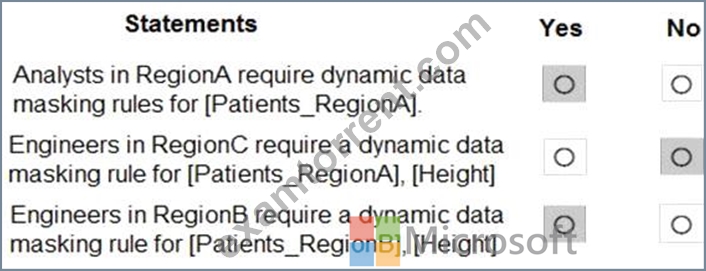
Reference:
https://docs.microsoft.com/en-us/azure/azure-sql/database/dynamic-data-masking-overview
Topic 2, Contoso Case StudyTransactional Date
Contoso has three years of customer, transactional, operation, sourcing, and supplier data comprised of 10 billion records stored across multiple on-premises Microsoft SQL Server servers. The SQL server instances contain data from various operational systems. The data is loaded into the instances by using SQL server integration Services (SSIS) packages.
You estimate that combining all product sales transactions into a company-wide sales transactions dataset will result in a single table that contains 5 billion rows, with one row per transaction.
Most queries targeting the sales transactions data will be used to identify which products were sold in retail stores and which products were sold online during different time period. Sales transaction data that is older than three years will be removed monthly.
You plan to create a retail store table that will contain the address of each retail store. The table will be approximately 2 MB. Queries for retail store sales will include the retail store addresses.
You plan to create a promotional table that will contain a promotion ID. The promotion ID will be associated to a specific product. The product will be identified by a product ID. The table will be approximately 5 GB.
Streaming Twitter Data
The ecommerce department at Contoso develops and Azure logic app that captures trending Twitter feeds referencing the company's products and pushes the products to Azure Event Hubs.
Planned Changes
Contoso plans to implement the following changes:
* Load the sales transaction dataset to Azure Synapse Analytics.
* Integrate on-premises data stores with Azure Synapse Analytics by using SSIS packages.
* Use Azure Synapse Analytics to analyze Twitter feeds to assess customer sentiments about products.
Sales Transaction Dataset Requirements
Contoso identifies the following requirements for the sales transaction dataset:
* Partition data that contains sales transaction records. Partitions must be designed to provide efficient loads by month. Boundary values must belong: to the partition on the right.
* Ensure that queries joining and filtering sales transaction records based on product ID complete as quickly as possible.
* Implement a surrogate key to account for changes to the retail store addresses.
* Ensure that data storage costs and performance are predictable.
* Minimize how long it takes to remove old records.
Customer Sentiment Analytics Requirement
Contoso identifies the following requirements for customer sentiment analytics:
* Allow Contoso users to use PolyBase in an A/ure Synapse Analytics dedicated SQL pool to query the content of the data records that host the Twitter feeds. Data must be protected by using row-level security (RLS). The users must be authenticated by using their own A/ureAD credentials.
* Maximize the throughput of ingesting Twitter feeds from Event Hubs to Azure Storage without purchasing additional throughput or capacity units.
* Store Twitter feeds in Azure Storage by using Event Hubs Capture. The feeds will be converted into Parquet files.
* Ensure that the data store supports Azure AD-based access control down to the object level.
* Minimize administrative effort to maintain the Twitter feed data records.
* Purge Twitter feed data records;itftaitJ are older than two years.
Data Integration Requirements
Contoso identifies the following requirements for data integration:
Use an Azure service that leverages the existing SSIS packages to ingest on-premises data into datasets stored in a dedicated SQL pool of Azure Synaps Analytics and transform the data.
Identify a process to ensure that changes to the ingestion and transformation activities can be version controlled and developed independently by multiple data engineers.
NEW QUESTION 118
You are designing a fact table named FactPurchase in an Azure Synaps Analytics dedicated SQL pool. The table contains purchases from suppliers for a retail store. FactPurchase will contain the following columns.
FactPurchase will have 1 million rows of data added daily and will contain three years of data.
Transact-SQL queries similar to the following query will be executed daily.
- A. replicated
- B. hash-distributed on PurchaseKey
- C. hash-distributed on DateKey
- D. round-robin
Answer: D
NEW QUESTION 119
You have an Azure Stream Analytics job that receives clickstream data from an Azure event hub.
You need to define a query in the Stream Analytics job. The query must meet the following requirements:
* Count the number of clicks within each 10-second window based on the country of a visitor.
* Ensure that each click is NOT counted more than once.
How should you define the Query?
- A. SELECT Country, Avg(*) AS Average
FROM ClickStream TIMESTAMP BY CreatedAt
GROUP BY Country, SlidingWindow(second, 10) - B. SELECT Country, Count(*) AS Count
FROM ClickStream TIMESTAMP BY CreatedAt
GROUP BY Country, TumblingWindow(second, 10) - C. SELECT Country, Avg(*) AS Average
FROM ClickStream TIMESTAMP BY CreatedAt
GROUP BY Country, HoppingWindow(second, 10, 2) - D. SELECT Country, Count(*) AS Count
FROM ClickStream TIMESTAMP BY CreatedAt
GROUP BY Country, SessionWindow(second, 5, 10)
Answer: B
Explanation:
Explanation
Tumbling window functions are used to segment a data stream into distinct time segments and perform a function against them, such as the example below. The key differentiators of a Tumbling window are that they repeat, do not overlap, and an event cannot belong to more than one tumbling window.
Example:
Reference:
https://docs.microsoft.com/en-us/azure/stream-analytics/stream-analytics-window-functions
NEW QUESTION 120
......
Exam Questions and Answers for DP-203 Study Guide Questions and Answers!: https://www.examtorrent.com/DP-203-valid-vce-dumps.html
Practice To DP-203 - ExamTorrent Remarkable Practice On your Data Engineering on Microsoft Azure Exam: https://drive.google.com/open?id=1oA8ahn63pxlyg33mJtAWUYmBP_9W0Pgf
